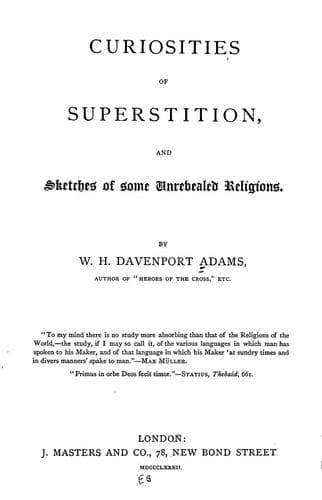
Curiosities of Superstition, and Sketches of Some Unrevealed ReligionsAdams, W. H. Davenport (William Henry Davenport)
Religion
Curiosities of Superstition, and Sketches of Some Unrevealed Religions
Adams, W. H. Davenport (William Henry Davenport)
Folklore; Religions; Superstition
Passing on to the Philippine Islands, we meet there with the Ahetas, who,
like the Orang-Lauts, have no religious system, but, unlike the
Orang-Lauts, cherish at least a religious sentiment. It appears that they
have learned from--or have taught--the Tanguianes, a brave race dwelling
in the vicinity, the practice of worshipping--for a day--the trunk of a
distorted tree, or a fragment of rock, in which they trace some fancied
resemblance to an animal. Then they turn away from it, and think no more
about gods until they encounter another strange and fantastical form, for
the existence of which they are unable to account: this, in turn, they
make the object of a fugitive devotion. For the dead their reverence is
pathetic. Year after year they visit their graves, with as much fidelity
as a Christian mourner, though without the Christian’s faith in a future
reunion, and place there a modest offering of tobacco and betel. The bows
and arrows of the departed are suspended above his grave on the day of
interment, and the Ahetas fondly believe that every night he rises from
his resting-place to pursue the shadowy hunt in the haunted glades of the
forest.
In the case of an aged person afflicted with a mortal illness, they adopt
too often a summary procedure, not waiting for him to die before they bury
him. But no sooner has the body been deposited in the grave, than it
becomes imperative, according to their traditions, that his death
should be avenged; and, accordingly, the warriors of the tribe sally
forth, with lance and arrow, to slay the first living creature they
encounter,--whether man, or stag, or wild hog, or buffalo. When thus in
quest of an expiatory victim, they take the precaution of breaking off the
young shoots of the shrubs as they pass by, and leave the broken ends
hanging in the direction of their roots, as a warning to travellers or
neighbours to shun the path they are taking; for were one of their own
people to be the first to come across the avengers, they dare not suffer
him to escape any more than Agamemnon could spare his daughter Iphigenia.
As she suffered for her father’s vow, so must the ill-fated Aheta suffer
for the custom of his tribe.
Public-domain text, read in full here on John Shaqi.
Reviews
Reviews
No reviews yet
Be the first to share your thoughts on this work.
Elsewhere in the archive
Join the Discussion
Join the discussion
Sign in to leave a comment or review.
Sign InorCreate an account