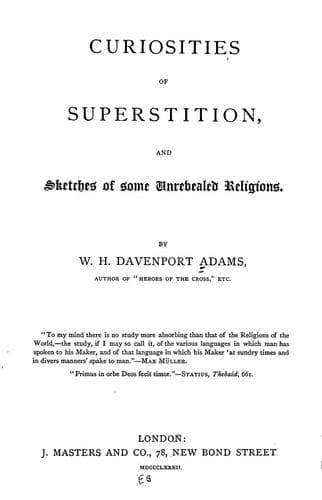
Curiosities of Superstition, and Sketches of Some Unrevealed ReligionsAdams, W. H. Davenport (William Henry Davenport)
Religion
Curiosities of Superstition, and Sketches of Some Unrevealed Religions
Adams, W. H. Davenport (William Henry Davenport)
Folklore; Religions; Superstition
Not less barbarous than the poor creatures who submit to his guidance,
the Tadibe is incapable, and probably not desirous, of improving their
moral condition. Similar impostors, claiming and exercising a similar
spiritual dictatorship,--_Schamans_, as the Tungusi call them, _Angekoks_
among the Eskimos, _Medicine-men_ among the Crees and Chepewyans,--we find
among all the Arctic tribes of the Old and New World, where their
authority has not been overthrown by Christianity or Buddhism; and this
dreary superstition still prevails over at least half a million of souls,
from the White Sea to the extremity of Asia, and from the Pacific to
Hudson’s Bay.
Like the peoples of Siberia, the Samojedes offer up sacrifices to the
dead, and perform various ceremonies in their honour. Like the North
American Indians, they believe that the desires and pursuits of the
departed continue exactly the same as if they were still living; and
hence, that they may not be in want of weapons or implements, they deposit
in or about the graves a sledge, a spear, a knife, an axe, a cooking-pot.
At the funeral, and for several years afterwards, the kinsmen sacrifice
reindeer over the grave.
When a chief or Starochina dies,--the owner, it may be, of several herds
of reindeer,--his nearest relatives fashion an image, which is kept in the
tent of the deceased, and receives the same measure of respect that was
paid to the man himself in his lifetime. At every meal it occupies his
accustomed seat; every evening it is solemnly undressed, and duly laid
down in his bed. For three years these honours are regularly paid; after
which the image is buried, in a belief that the body must by that time
have decayed, and lost all recollection of the past. Only the souls of the
Tadibes, and of those who have died a violent death, are in the enjoyment
of immortality, and hover about the air as disembodied spirits.
THE OSTIAKS.
Further to the east, and occupying the northernmost part of Siberia from
the Oural Mountains to Kamtschatka, are the Ostiaks.
The Russians have imposed upon this people the Christian religion, as
taught by the Greek Church; but it seems probable that the majority adhere
in secret to their heathen creed. Madame Felinska, a Polish lady, who for
some years lived in exile in Siberia, relates that, one day, when she was
seeking a pathway through a wood, she came upon a couple of Ostiaks, on
the point of performing their devotions. These are certainly of a much
simpler kind than the rites enjoined by the Greek Church: the worshipper
simply places himself before a tree--he appears to prefer the larch--in
some sequestered forest-nook, and performs in rapid succession the most
extravagant contortions and gestures. As the practice is prohibited by the
Russian Government, it is necessarily made a matter of secresy.
Public-domain text, read in full here on John Shaqi.
Reviews
Reviews
No reviews yet
Be the first to share your thoughts on this work.
Elsewhere in the archive
Join the Discussion
Join the discussion
Sign in to leave a comment or review.
Sign InorCreate an account