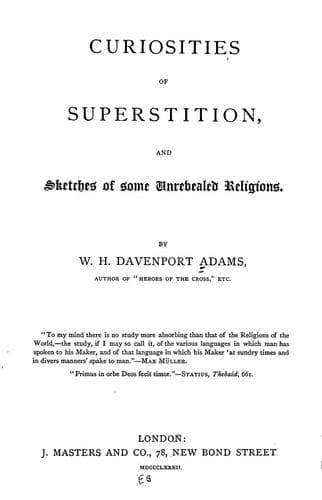
Curiosities of Superstition, and Sketches of Some Unrevealed ReligionsAdams, W. H. Davenport (William Henry Davenport)
Religion
Curiosities of Superstition, and Sketches of Some Unrevealed Religions
Adams, W. H. Davenport (William Henry Davenport)
Folklore; Religions; Superstition
An Ostiak generally carries about him a rude image of one of the deities
or demons which he adores under the name of Schaïtan; but he conforms to
Russian customs by wearing a small crucifix of copper on his breast. The
Schaïtan is a rude imitation of the human figure, carved in wood. It is of
different sizes, according to the uses for which it is intended; if for
wearing on the person, it is a miniature doll; but as part of the
furniture of an Ostiak’s hut it is made on a large scale. It is always
attired in seven pearl-broidered chemises, and suspended to the neck by a
string of silver coins. In every hut it fills the place of
honour,--sometimes in company with an image of the Virgin Mary or some
Russian saint; and when they sit down to their meals, the Ostiaks are
careful to offer it the daintiest morsels, smearing its lips with fish or
raw game; this sacred duty fulfilled, they attack with eagerness the
viands set before them.
The Ostiak priests are called _Schamans_. Their influence is very great,
but is wholly employed in the promotion of their own selfish interests,
through the encouragement of the basest superstitions.
WEATHER-CONJURING AMONG THE MONGOLS.
There are many allusions in Mongol history to the practice of
weather-conjuring. The operation was performed by means of a stone
supposed to be endowed with magical virtues, called _Yadah_ or _Jadah
Tásh_; this was suspended over or hung in a basin of water with sundry
ceremonies. Ibn Mohalhal, an early Arab traveller, asserts that the
_Kímák_, a great tribe of the Turks, possessed such a stone. In the war
waged against Chinghiz and Aung Khan by a powerful tribal confederation in
1202, it is recorded that Sengun, the son of Aung Khan, who had been
despatched to arrest the enemy’s advance, caused them to be enchanted, so
that all the movements they attempted against him were defeated by dense
mists and blinding snow-storms. So thick was the mist, so intense was the
darkness, that men and horses stumbled over precipices, and many also
perished with cold.
The celebrated conqueror, Timur, in his _Memoirs_, records that the Jets
resorted to incantations to produce heavy rains which hindered his cavalry
from acting against them. A _Yadachi_, or weather-conjuror, was taken
prisoner, and after he had been beheaded the storm ceased.
Babu refers to one of his early friends, Khwaja ka Mulai, as conspicuous
for his skill in falconry and his knowledge of _Yadageri_, or the science
of inducing rain and snow by means of enchantment. The Russians were much
distressed by heavy rains in 1552, when besieging Kazan, and universally
ascribed the unfavourable weather to the arts of the Tartar queen, who was
an enchantress.
Public-domain text, read in full here on John Shaqi.
Reviews
Reviews
No reviews yet
Be the first to share your thoughts on this work.
Elsewhere in the archive
Join the Discussion
Join the discussion
Sign in to leave a comment or review.
Sign InorCreate an account