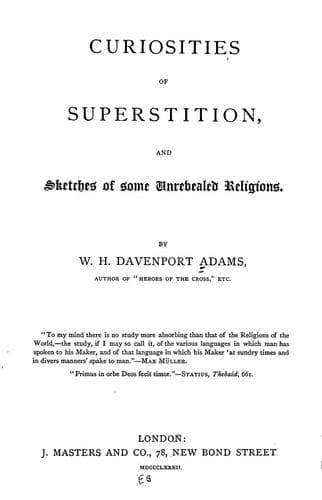
Curiosities of Superstition, and Sketches of Some Unrevealed ReligionsAdams, W. H. Davenport (William Henry Davenport)
Religion
Curiosities of Superstition, and Sketches of Some Unrevealed Religions
Adams, W. H. Davenport (William Henry Davenport)
Folklore; Religions; Superstition
Early in the 18th century, the Emperor Shi-tsung issued a proclamation
against rain-conjuring, addressed to the Eight Banners of Mongolia. “If,”
indignantly observes the Emperor, “if I, offering prayers in sincerity,
have yet cause to fear that it may please heaven to leave MY prayer
unanswered, it is truly intolerable that mere common people wishing for
rain should of their own fancy set up altars of earth; and bring together
a rabble of Hoshang (Buddhist Bonzes) and Taossi to conjure the spirits to
gratify their wishes.”
The belief in the efficacy of weather-conjuring prevailed all over Europe.
In the _Cento Novelle Antiche_, certain necromancers gave specimens of
their skill before the Emperor Frederic Barbarossa; and the weather began
to be overcast; and lo, of a sudden rain fell with continued thunders and
lightnings, as if the world were come to an end, and hailstones of the
size and appearance of steel caps.
IN TIBET.
Marco Polo, describing his visit to the Kaan’s Palace at Chandu, once
known as Kaipingfu, speaks of the immense stud of pure white mares which
the Kaan kept there, and adds:--“When the Kaan sets out from the Park on
the 28th of August, the milk of all those mares is taken and sprinkled on
the ground. And this is done on the injunction of the Idolaters and
Idol-priests, who affirm that it is an excellent thing to sprinkle that
milk on the ground every 28th of August, so that the Earth and the Air and
the False Gods shall have their share of it, and likewise the spirits that
inhabit the Air and the Earth. And then those beings will protect and
bless the Kaan and his children and his wives and his folk and his gear,
and his cattle and his horses, his corn and all that is his.”
Marco Polo proceeds:--“But I must now tell you a strange thing which
hitherto I have forgotten to mention. During the three months of every
year that the Emperor resides at that place, if it should happen to be bad
weather, there are enchanters and astrologers in his train, who are such
adepts in necromancy and diabolic arts, that they are able to prevent any
cloud or storm from passing over the spot on which the Emperor’s Palace
stands. The sorcerers who do this are called Tebet and Kesimar, which are
the names of two nations of idolaters. Whatever they do in this way is by
the help of the Devil, but they make those people believe that it is
compassed by dint of their own sanctity and the help of GOD....
Public-domain text, read in full here on John Shaqi.
Reviews
Reviews
No reviews yet
Be the first to share your thoughts on this work.
Elsewhere in the archive
Join the Discussion
Join the discussion
Sign in to leave a comment or review.
Sign InorCreate an account