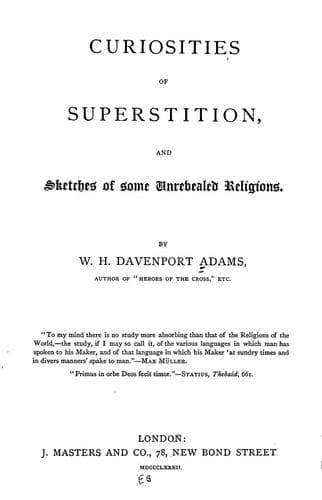
Curiosities of Superstition, and Sketches of Some Unrevealed ReligionsAdams, W. H. Davenport (William Henry Davenport)
Religion
Curiosities of Superstition, and Sketches of Some Unrevealed Religions
Adams, W. H. Davenport (William Henry Davenport)
Folklore; Religions; Superstition
Another kind of devotees were called the Seusin, men of extraordinary
abstemiousness, who led a life of extreme endurance. Their sole food was
bran mixed with hot water, so that one might call their lives a prolonged
fast. They had numerous idols, and idols of a monstrous size, but they
also worshipped fire. Idolaters not belonging to this sect naturally
called them “heretics,” on the old principle that “my doxy” is
“orthodoxy,” and “your doxy” “heterodoxy.” Their dresses were made of
hempen stuff, black and blue, and they slept upon mats. In fact, says
Marco Polo, “their asceticism is something remarkable.”
* * * * *
Chandu, or Xanadu, and its palace, suggested to Coleridge one of his most
exquisite passages of description:--
“In Xanadu did Kubla Kaan
A stately pleasure dome decree:
Where Alph, the sacred river, ran,
By caverns measureless to man,
Down to a sunless sea.
So twice five miles of fertile ground,
With walls and towers were girdled round:
And there were gardens bright with sinuous rills,
Where blossomed many an incense-bearing tree;
And here were forests, ancient as the hills,
Enfolding sunny spots of greenery.”
Xanadu has disappeared, and so has its palace, but the superstitions
practised in it are still in vogue among the Mongolian peoples. The word
“Bakhshi,” however, has come to have a different meaning in different
districts; among the Kirghiz Kazzaks it is applied, as Marco Polo applied
it, to a conjuror or medicine-man; among the modern Mongols it signifies
“a teacher,” and is bestowed on the oldest and most learned priest of a
community; in Western Turkestan it means “a bard;” in our Indian army it
is “a paymaster.”
The jugglery of the goblets, to which Marco Polo refers, was not uncommon
in Mediæval Europe. Colonel Yule cites[37] the Jesuit Delrio as lamenting
the credulity of certain princes, otherwise of pious repute, who allowed
diabolic tricks to be played in their presence; as for instance that
things of iron, and silver goblets, or other heavy articles, should be
moved by bounds from one end of a table to the other, without the use of a
magnet or of any attachment. The pious prince appears to have been Charles
IX., and the conjuror a certain Cesare Maltesio. In old legends this
trick is one of the sorceries ascribed to Simon Magus. “He made statues to
walk; leapt into the fire without being burnt; flew in the air; made bread
of stones; changed his shape; assumed two faces at once,”--an
accomplishment not confined to conjurors,--“converted himself into a
pillar; caused closed doors to fly open of their own will; and made the
vessels in a house seem to move of themselves.”
Public-domain text, read in full here on John Shaqi.
Reviews
Reviews
No reviews yet
Be the first to share your thoughts on this work.
Elsewhere in the archive