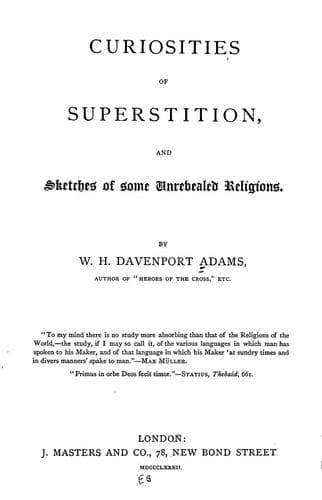
Curiosities of Superstition, and Sketches of Some Unrevealed ReligionsAdams, W. H. Davenport (William Henry Davenport)
Religion
Curiosities of Superstition, and Sketches of Some Unrevealed Religions
Adams, W. H. Davenport (William Henry Davenport)
Folklore; Religions; Superstition
Colonel Yule asserts that the profession and practice of exorcism and
magic in general is much more prominent in Lamaism, or Tibetan Buddhism,
than in any other known form of that religion. “Indeed,” he says, “the old
form of Lamaism, as it existed in Marco Polo’s day, and till the reforms
of Tsongkhapa (1357-1419), and as it is still professed by the _Red_ sect
in Tibet, seems to be a kind of compromise between Indian Buddhism and the
old indigenous Shamanism. Even the reformed doctrine of the Yellow sect
recognises an orthodox kind of magic, which is due in great measure to the
combination of Sivaism with the Buddhist doctrines, and of which the
institutes are contained in the vast collection of the _Jud_ or Tantras,
recognised among the holy books. The magic arts of this code open even a
short road to the Buddhahood itself. To attain that perfection of power
and wisdom culminating in the cessation of sensible existence, requires,
according to the ordinary paths, a period of three _asankhyas_ (or say
Unaccountable Time × 3), whereas by means of the magic arts of the
_Tantras_, it may be reached in the course of three _rebirths_ only, nay,
of one! But from the Tantras also can be learned how to acquire miraculous
powers for objects entirely selfish and secular, and how to exercise these
by means of _Dhárani_, or mystic Indian charms.”
The commonplace and vulgar exhibition of such exploits as blowing fire,
cutting off heads, and swallowing knives, is formally repudiated by the
orthodox Yellow Lamas; but as the crowd cannot be satisfied without them,
each of the great Yellow Lama monasteries in Tibet maintains a conjuror,
as of old each European sovereign kept his jester. This conjuror is not a
member of the monastic fraternity, and lives in a particular part of the
convent, out of the atmosphere of their sanctity. He is called _Choicong_,
or protector of religion, and is free to marry. The Choicong hand down
their magic lore from generation to generation orally, and by their cries
and howls, and their frenzied gestures, and their fantastic dress, are
connected with the Shamanist devil dancers.
Public-domain text, read in full here on John Shaqi.
Reviews
Reviews
No reviews yet
Be the first to share your thoughts on this work.
Elsewhere in the archive
Join the Discussion
Join the discussion
Sign in to leave a comment or review.
Sign InorCreate an account