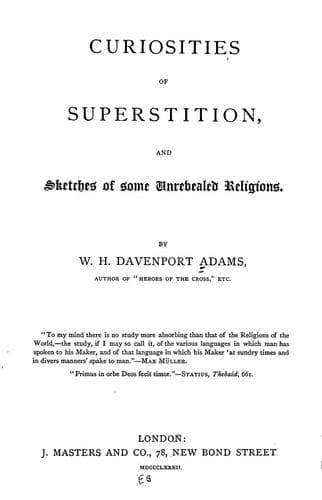
Curiosities of Superstition, and Sketches of Some Unrevealed ReligionsAdams, W. H. Davenport (William Henry Davenport)
Religion
Curiosities of Superstition, and Sketches of Some Unrevealed Religions
Adams, W. H. Davenport (William Henry Davenport)
Folklore; Religions; Superstition
Magic seems to have always borne the same character in every country. The
marvels accomplished by the Indian mystic charms, or _Dhárani_, are
exactly those which the Mediæval magicians of Europe professed to achieve.
To make water flow backwards, to resuscitate the dead, to fly through the
air, to read a man’s inmost thoughts, these were the wonders done by Simon
Magus in his day, and by Albertus Magnus and his followers in their day;
and form what may be called the ordinary stock-in-trade of the old
necromancers. The Bakhshis included them in their series of performances.
“There are certain men,” says Ricold, “whom the Tartars honour above all
in the world, viz., the _Baxitæ_, (or _Bakhshis_), who are a kind of idol
priests. These are men from India, persons of deep wisdom, well conducted,
and of the gravest morals. They are usually acquainted with magic arts,
and depend on the counsel and aid of demons; they exhibit many illusions,
and predict some future events. For instance, one of eminence among them
was said to fly; the truth however was (as it proved) that he did not fly,
but did walk close to the surface of the ground without touching it; and
would seem to sit down without having any substance to support him.” Ibn
Batuta describes a performance of this kind as witnessed by him at Delhi,
in the presence of Sultan Mahomed Tughlak. Francis Valentyn, at a later
date, speaks of it as common in India. He was told, he says, that a man
would first go and sit upon three sticks which had been so put together as
to form a tripod, after which, first one stick, then a second, then a
third would be removed from under him, and yet the man would not fall, but
would remain suspended in the air. He could not bring himself to believe
it, so manifestly contrary was it to reason, yet he had spoken with two
friends who had both seen it done on the same occasion, and one of them
mistrusting his own eyes, had felt about with a long stick to ascertain if
there were not something on which the body rested, but could discover
nought.
Superstition, like history, repeats itself,--some of the marvels with
which the Lama conjurors and the Tartar Bakhshis deluded their people are
repeated by the spiritualistic “mediums,” of the present day and put
forward by them as the credentials of their pretended mission.
They fall short, however, of the extraordinary feats performed by the
professional jugglers who laid no claim to a religious character, if we
may credit the accounts of the early travellers. Ibn Batuta, for instance,
gravely describes what he saw, or thought he saw, at a great entertainment
given by the Viceroy of Khansa:--
Public-domain text, read in full here on John Shaqi.
Reviews
Reviews
No reviews yet
Be the first to share your thoughts on this work.
Elsewhere in the archive
Join the Discussion
Join the discussion
Sign in to leave a comment or review.
Sign InorCreate an account