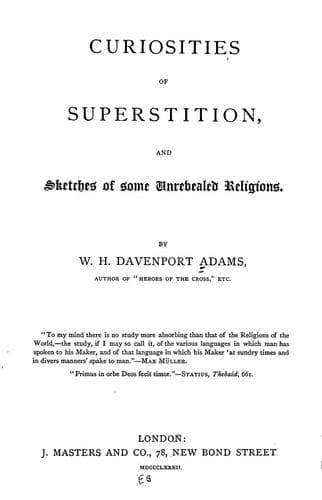
Curiosities of Superstition, and Sketches of Some Unrevealed ReligionsAdams, W. H. Davenport (William Henry Davenport)
Religion
Curiosities of Superstition, and Sketches of Some Unrevealed Religions
Adams, W. H. Davenport (William Henry Davenport)
Folklore; Religions; Superstition
In his childhood he has to be initiated into certain mysteries. What those
are Mr. Winwood Reade learned from a negro steward, who informed him that
he was taken into a fetich, or idol house, severely flogged, and plastered
with goat-dung: this ceremony, like the rites of masonry, being conducted
to the sound of music. Afterwards from behind a kind of screen or shrine
issued uncouth and terrible sounds such as he had never before heard.
These, he was told, emanated from the spirit called Ukuk. He afterwards
brought to Mr. Winwood Reade the instrument with which the fetich-man
produces the noise. It may be described as a whistle made of hollowed
mangrove wood, about two inches long, and covered at one end with a scrap
of bat’s wing. For a period of five days after initiation the novice wears
an apron of dry palm leaves.
He is next instructed in the science of fetich; and afterwards he learns
what kinds of food are forbidden to his tribe, for one tribe may not eat
crocodile, another hippopotamus, nor a third buffalo. He learns to
reverence and dread the spirit _Ukuk_, which dwells, it is said, in the
bowels of the earth, and visits the upper world only when he has some
business to perform. On the occasion of his visits, he abides in the
fetich-house, which is built in a peculiar form, roofed with dry plantain
leaves, and always kept in darkness. Thence strange dread sounds, like the
growling of a tiger, are heard to proceed, so that the women and children
shudder as they listen. When the mangrove-tube is thus at work, the
initiated hasten to the house, and a “lodge” or “council” is held.
“The natives of Equatorial Africa worship also the spirits of their
ancestors; a worship for which their minds are prepared by the veneration
which they pay to old age. Young men never enter the presence of an aged
person without curtseying (a genuine curtsey like that of a charity-school
girl), and passing in a stooping attitude, as if they were going under a
low door. When seated in his presence, it is always at a humble distance.
If they hand him a lighted pipe, or a mug of water, they fall on one knee.
If an old man, they address him as _rora_--father; if an old woman as
_ngwe_--mother. It is customary for only the old people to communicate bad
news to one another; and it is not to be wondered at that we find the
negroes such perfect courtiers, since it is the etiquette of the country
that the aged should only be addressed in terms of flattery and adulation.
“When they die their relics are honoured. In the Congo country their
bodies are dried into mummies. Here, their bones are sometimes stored up
and visited at set periods. Or, when a person noted for his wisdom has
died, his head, when partially decomposed, is often cut off and suspended,
so as to drip upon a mass of chalk placed underneath. This matter is
supposed to be the wisdom which formerly animated the brain, and which,
rubbed upon the foreheads of others, will communicate its virtue.”
Public-domain text, read in full here on John Shaqi.
Reviews
Reviews
No reviews yet
Be the first to share your thoughts on this work.
Elsewhere in the archive
Join the Discussion
Join the discussion
Sign in to leave a comment or review.
Sign InorCreate an account