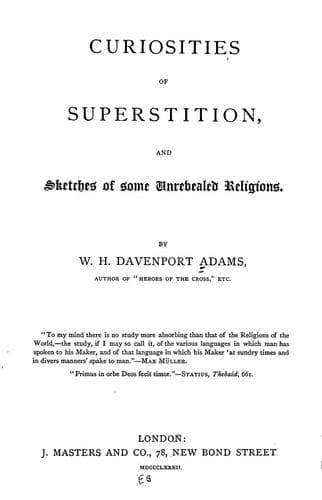
Curiosities of Superstition, and Sketches of Some Unrevealed ReligionsAdams, W. H. Davenport (William Henry Davenport)
Religion
Curiosities of Superstition, and Sketches of Some Unrevealed Religions
Adams, W. H. Davenport (William Henry Davenport)
Folklore; Religions; Superstition
It can easily be understood how this reverence paid to the relics of one’s
ancestors would develope into the worship of their spirits. The Equatorial
Savage believes that the manes of his forefathers influence his life and
fortunes entirely to his advantage, and by a dying friend or relative will
often send messages to them. Mr. Reade adds that a son has been known to
kill his aged mother from a conviction that her spirit would be of more
service to him than her substance; a reason for matricide which would
hardly be accepted as conclusive in civilised countries! The savage lives,
however, in constant communion and sympathy with the spirit-world. The
visions which come to him in his dreams, and the sounds which he fancies
himself to hear, are those of the Unseen. And as he is always brooding
upon his dreams and relating them to his friends, he necessarily dreams
the more, until it becomes difficult for him to draw a line between the
dream and the reality.
When any calamity befalls the tribe, or at the approach of any imminent
danger, they gather together on the brink of some lofty bluff, or on the
forest’s haunted threshold, and stretching their arms towards the sky,
while the women wail and the children weep, they call upon the spirits of
the departed to come and help them.
They have a remarkable ceremony which illustrates the force and vividness
of their belief in spirits:
When the dead are weary of staying in the bush, they come for one of their
people whom they most affect. And the spirit will say to the man: “I am
tired of dwelling in the bush; please to build for me in the town a little
house as close as possible to your own.” And he tells him to dance and
sing too; and accordingly the man assembles the women at night to join in
dance and song.
Then, next day, the people repair to the grave of the _Obambo_, or ghost,
and make a rude idol; after which the bamboo bier on which the body is
conveyed to the grave, and some of the dust of the ground, are carried
into a little hut erected near the house of the visited, and a white cloth
is draped over the door.
It is a curious fact, which seems to show that they have a legend
something like the old Greek myth of Charon and the Styx, that in one of
the songs chanted during this ceremony occurs the following line: “You are
well dressed, but you have no canoe to carry you across to the other
side.”
Public-domain text, read in full here on John Shaqi.
Reviews
Reviews
No reviews yet
Be the first to share your thoughts on this work.
Elsewhere in the archive
Join the Discussion
Join the discussion
Sign in to leave a comment or review.
Sign InorCreate an account