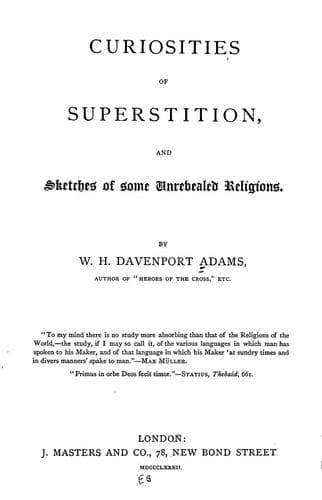
Curiosities of Superstition, and Sketches of Some Unrevealed ReligionsAdams, W. H. Davenport (William Henry Davenport)
Religion
Curiosities of Superstition, and Sketches of Some Unrevealed Religions
Adams, W. H. Davenport (William Henry Davenport)
Folklore; Religions; Superstition
In contrast to their loud sorrow was the silent mourning of the men who,
hushed and fasting, sat in the chief house of the town. In their midst
crouched the seven years old boy, the marks of a severe wound visible on
his arm, and his wrists securely bound together. The dogged expression of
the child’s face was something wonderful. It wore that look of stolid
endurance which seems natural to the negro. One of the men with horrible
pleasantry held an axe below his eyes; but the boy contemplated it without
emotion--he displayed all the cold indifference of the ancient Stoicism.
When his name was first mentioned, his eyes flashed; but this indication
of passion was only momentary. He showed the same indifference when a plea
was put in for his life, as when, just before, he had been threatened and
taunted with death.
Mr. Reade did not see the unfortunate mother, but was afterwards told that
she had been flogged into confessing that she and she only had bewitched
the man. Her son had acknowledged the crime as soon as he was charged with
it. It is well known that such confessions amount to nothing. During the
witch epidemic in Mediæval Europe, scores of unhappy creatures confessed
to the practice of witchcraft, though by so doing they doomed themselves
to death. The imagination in some way or other is powerfully excited, and
completely overcomes the judgment; or it may be from a fear of torture or
a thirst for notoriety that such confessions are made.
Mr. Mackey, the missionary, said that he had come to speak to Okota, the
nearest kinsman of the dying chief, upon whom, in all such cases, the
responsibility rests. Okota came out from the throng, placed his stool
near the feet of the missionary, and listened to him attentively.
“Death,” said the missionary, “must come to all. It is foolish to think
that because a man dies he has been bewitched.”
“Yes,” replied Okota, “death must come to all, but not always from GOD.
Sometimes it comes from the hand of man.”
“But how do you know that in this instance it comes from the hand of man?”
“The woman has been given _quai_ (the drink of ordeal) to drink, and the
_quai_ says that she bewitched him.”
“But the _quai_ is not always right. When Cabinda went to the Muni, he was
a long time lost. All people said that he was dead. A man you declared was
the witch, you gave him _quai_; _quai_ said that the man had killed
Cabinda, but Cabinda came back alive, and _quai_ was wrong.”
A roar of laughter acknowledged the force of this pertinent reply.
“It is not only _quai_,” said Okota, “the woman confesses that she has
used the arts of witchcraft. Will any man come to you and say, ‘I have
stolen your fowl,’ if he has not stolen it? This woman is killing my
brother, when my brother is dead I will kill her.”
After so decisive a declaration, further argument was useless, and Mr.
Mackey was compelled to retire, unsuccessful.
Public-domain text, read in full here on John Shaqi.
Reviews
Reviews
No reviews yet
Be the first to share your thoughts on this work.
Elsewhere in the archive
Join the Discussion
Join the discussion
Sign in to leave a comment or review.
Sign InorCreate an account