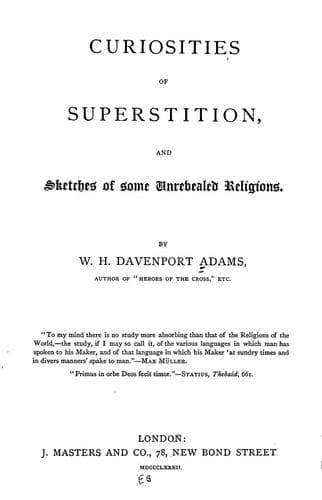
Curiosities of Superstition, and Sketches of Some Unrevealed ReligionsAdams, W. H. Davenport (William Henry Davenport)
Religion
Curiosities of Superstition, and Sketches of Some Unrevealed Religions
Adams, W. H. Davenport (William Henry Davenport)
Folklore; Religions; Superstition
“When a man is sick a long time,” said Mongilombas, “they call _Ngembi_,
and if she cannot make him well, the fetich-man. He comes at night, in a
white dress, with cock’s feathers on his head, and having his bell and
little glass. He calls two or three relations together into a room. He
does not speak, but always looks in his glass. Then he tells them that the
sickness is not of Mbwiri, nor of Obambo, nor of God, but that it comes
from a witch. They say to him, ‘What shall we do?’ He goes out and says,
‘I have told you: I have no more to say.’ They give him a dollar’s worth
of cloth; and every night they gather together in the street, and they
cry, ‘I know that man who witch my brother. It is good for you to make him
well.’ Then the witch makes him well. But if the man do _not_ recover,
they call the bush doctor from the Shekani country. He sings in the
language of the bush. At night he goes into the street; all the people
flock about him. With a tiger-cat skin in his hand, he walks to and fro,
until, singing all the while, he lays the tiger skin at the feet of the
witch. At the conclusion of his song the people seize the witch, and put
him, or her, in chains, saying, ‘If you don’t restore our brother to
health, we will kill you.’”
One evening, as Mr. Reade was sitting in a mission house at Corisco, with
the windows open, he heard a wild and piteous cry rising from a village at
a short distance. A sudden silence fell upon his friends. The school was
in the next room, and two girls who belonged to that village lifted up
their voices and wept. It was the death-knell, and the knell of more lives
than one. A chieftain for some time had been lying in a hopeless
condition, and a woman had been denounced for having bewitched him. She
had a son of about seven years of age, and fearing lest when he reached
manhood, he should become her avenger, the accusers included him also in
their denunciation. Both had been made prisoners, and on the death of the
chief would be killed.
The following day was Sunday, and Mr. Reade accompanied Mr. Mackay, the
missionary, to the village. The man was not dead; but he had suddenly
become speechless, and his attendants had concluded that the spirit had
departed. Entering the house, Mr. Reade found him lying on the bamboo
bedstead in a state of stupor. The house was thronged with women, who had
stripped off their garments and shaved the heads in token of mourning, and
were “raining tears” in their purchased and admirably acted grief.
Sometimes one of them would sit by his side, and flinging her arms around
him, would shriek--almost in the very words of the Irish death-wail,--“Why
did ye die, darling? why did ye die?” For they regarded him as really
dead, when he could neither look at them nor speak to them.
Public-domain text, read in full here on John Shaqi.
Reviews
Reviews
No reviews yet
Be the first to share your thoughts on this work.
Elsewhere in the archive
Join the Discussion
Join the discussion
Sign in to leave a comment or review.
Sign InorCreate an account