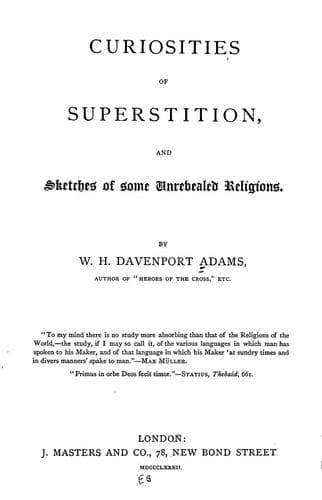
Curiosities of Superstition, and Sketches of Some Unrevealed ReligionsAdams, W. H. Davenport (William Henry Davenport)
Religion
Curiosities of Superstition, and Sketches of Some Unrevealed Religions
Adams, W. H. Davenport (William Henry Davenport)
Folklore; Religions; Superstition
The interest attaching to these women is derived from the fact that it was
of old the custom, among the Zulu and other South African tribes, to
attribute all mishaps or catastrophes, political or social, to the agency
of witches. It is not for Englishmen to look down with contempt upon this
manifestation of barbarism and ignorance, considering that a similar
belief prevailed very generally among us up to the reign of Charles I.,
and, in truth, is not wholly extinct even now: while the extent to which
the science of witch-finding was developed in New England will be known to
every reader of Cotton Mather.
When the community had resolved that a certain misfortune was due to the
witches, the next step obviously would be to detect and punish them. For
this purpose the king would summon a great meeting, and cause his subjects
to sit on the ground in a ring or circle, for four or five days. The
witch-finders took their places in the centre, and as they gradually
worked themselves up to a frantic state of frenzy, resembling demoniacal
possession, they lightly switched with their quagga-tail one or other of
the trembling spectators, who was immediately dragged away and butchered
on the spot. And not only he, but all the living things in his hut--wives
and children, dogs and cats--not one was left alive, nor was a stick left
standing. Sometimes a whole kraal would be exterminated in this way; and
the reader will perceive how terribly the cruel custom could be made to
gratify private revenge or to work out the king’s tyrannical inclinations.
A terrible little sorceress is described under the name of Nozilwane,[42]
whose weird wistful glance had in it something uncanny and uncomfortable.
She was really dressed beautifully for her part, in lynx skins folded over
and over from waist to knee, the upper part of her body being covered by
strings of wild beasts’ teeth and fangs, beads, skeins of gaily-coloured
yarn, strips of snake’s skin, and fringes of Angora-goat fleece. This, as
a decoration, was both graceful and effective; it was worn round the body
and above each elbow, and fell in soft white flakes among the brilliant
colouring and against the dusky skin. Lynx-tails depended like lappets on
each side of her face, which was overshadowed and almost hidden by a
profusion of sakabula feathers. “This bird,” says Lady Barker, “has a very
beautiful plumage, and is sufficiently rare for the natives to attach a
peculiar value and charm to the tail-feathers; they are like those of a
young cock, curved and slender, and of a dark chestnut colour, with a
white eye at the extreme tip of each feather.” Among all this thick,
floating plumage were interspersed small bladders, and skewers or pins
wrought out of tusks. Each witch-finder wore her own hair, or rather wool;
highly greased, and twisted up with twine until it ceases to wear the
appearance of hair, and hangs around the face like a thick fringe, dyed
deep red.
Public-domain text, read in full here on John Shaqi.
Reviews
Reviews
No reviews yet
Be the first to share your thoughts on this work.
Elsewhere in the archive
Join the Discussion
Join the discussion
Sign in to leave a comment or review.
Sign InorCreate an account