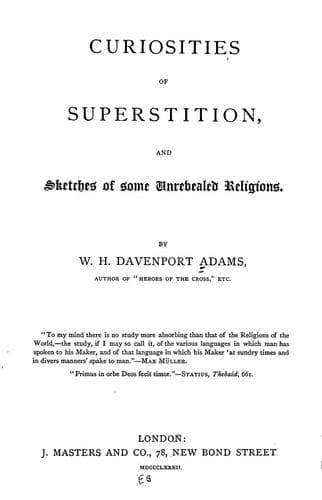
Curiosities of Superstition, and Sketches of Some Unrevealed ReligionsAdams, W. H. Davenport (William Henry Davenport)
Religion
Curiosities of Superstition, and Sketches of Some Unrevealed Religions
Adams, W. H. Davenport (William Henry Davenport)
Folklore; Religions; Superstition
Bent double, and with a creeping, cat-like gait, as if seeking a trail,
out stepped Nozilwane. Every movement of her undulating body kept time to
the beat of the girls’ hands and their low crooning chant. Presently she
pretended to find the thing she sought, and with a series of wild
pirouettes leaped into the air, shaking her spears and brandishing her
little shield like a Bacchante. Nowamso, another of the party, was
determined that her companion should not carry off all the applause, and
she too, with a yell and a leap, sprang into the dance to the sound of
louder grunts and harder hand-claps. Nowamso showed much anxiety to
display her back, where a magnificent snake skin, studded in a regular
pattern with brass-headed nails, floated like a stream. She was attired
also in a splendid kilt of leopard skins, decorated with red rosettes, and
her toilette was considered more careful and artistic than any of the
others. Brighter her bangles, whiter her goat-fringes, and more
elaborately painted her face. Nozilwane, however, had youth and a
wonderful self-reliance on her side. The others, though they all joined in
and hunted out an imaginary enemy, and in turn exulted over his discovery,
soon became breathless and spent, and were glad when their attendants led
them away to be anointed and to drink water.
“As for another of the ‘witch-finders,’ the great, big Nozinyanga, she
danced like Queen Elizabeth, ‘high and disposedly,’ and no wonder, for I
should think she weighed at least fifteen stone. Ungiteni, in a petticoat
of white Angora-goat skin, and a corsage of bladders and teeth, beads and
viper skins, was nothing remarkable; neither was Um-à-noujozzla, a
melancholy-looking personage, with an enormous wig-like coiffure of red
woollen ringlets and white skewers. The physiognomy, too, was a trifle
more stolid and commonplace than that of her comrades, and altogether she
gave me the impression of being a sensible, respectable woman, who was
very much ashamed of herself for playing such antics. However, she
brandished her divining brush with the rest, and cut in now and then to
‘keep the fleer’ with the untiring Nozilwane.”
Lady Barker and her friends grew tired of this imaginary “witch-finding,”
and to end the affair it was proposed to test the professed power of the
“weird women” to discover lost property. A silver pipe stem had recently
“gone a-missing,” and they were requested to find what had been lost, and
where. They set to work in a curious and interesting way. In front,
squatted on heels and haunches, a semicircle of about a dozen men, who
were supposed to have invited the assistance of the sisterhood. They had
no idea of what was asked for, and were told to go on with their part
until a signal was given that the article had been named.
“What is it the Inkos has lost?” they cried; “discover, reveal, make plain
to us.”
Public-domain text, read in full here on John Shaqi.
Reviews
Reviews
No reviews yet
Be the first to share your thoughts on this work.
Elsewhere in the archive
Join the Discussion
Join the discussion
Sign in to leave a comment or review.
Sign InorCreate an account