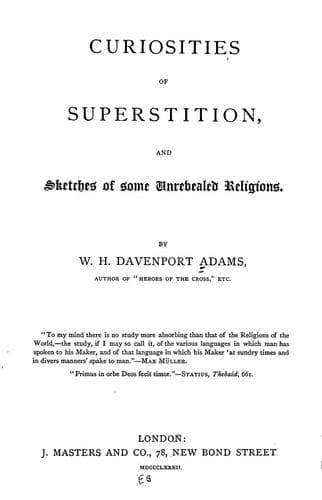
Curiosities of Superstition, and Sketches of Some Unrevealed ReligionsAdams, W. H. Davenport (William Henry Davenport)
Religion
Curiosities of Superstition, and Sketches of Some Unrevealed Religions
Adams, W. H. Davenport (William Henry Davenport)
Folklore; Religions; Superstition
There can be no question as to the antiquity or universality of
Serpent-Worship, whatever may be the difference of opinion as to its
origin. According to Bryant it began in Chaldea, and was “the first
variation from the purer Zabaism.” But this statement requires from us a
brief preliminary explanation of that ancient form of worship.
Zabaism, or Zabism, has had its two sects,--first the Chaldean Zabians of
the Kuran,--the “Parsified” Chaldee heathen, or non-Christian
Gnostics,--the ancestors of the present Mendaites, or so-called Joannes
Christians, who reside in the neighbourhood of the Persian Gulf, and speak
a corrupt form of Chaldee-Aramaic. And second, the Pseudo-Zabians, or
Syrian Zabians, in Harran, Edessa, Rakkah, and Bagdad. It is the latter
who now chiefly represent Zabism.
The first named, or Chaldean Zabians, who transferred the name to the
Harranic, and greatly influenced the development of the peculiar system of
the latter, are the people so designated in the Kuran, and by the
Mohammedans of to-day. The Harranians, who rose about A.D. 830, profess to
derive their denomination from one Zâbi, who is variously called a son of
Seth, son of Adam, or a son of Enoch or Idris, or a son of Methuselah, or
of some fictitious Badi or Mari, a supposed companion of Abraham; while
Mohammedan writers trace it to the word _ssaba_, “to turn, to move,”
because its professors turned from the path of true religion, that is,
Islam, or, as the Zabians say, because they have turned _to_ the proper
faith.
The Zabian creed, as professed by the Harranic Zabians, would appear to
resolve itself into the following elements:--
It teaches that the Creator is, in His essence, primitivity, originality,
and eternity, One; but in His numerous manifestations in bodily figures,
manifold. Chiefly He is personified by the seven principal planets, and by
the good, knowing, excellent earthly bodies. This, however, is without any
disturbance of His unity. It is, say the Zabians, as if the seven planets
were His seven limbs, and as if our seven limbs were His seven spheres in
which He manifests Himself,--so that He speaks with our tongues, sees with
our eyes, hears with our ears, touches with our hands, comes and goes with
our feet, and acts through our members.
Public-domain text, read in full here on John Shaqi.
Reviews
Reviews
No reviews yet
Be the first to share your thoughts on this work.
Elsewhere in the archive
Join the Discussion
Join the discussion
Sign in to leave a comment or review.
Sign InorCreate an account