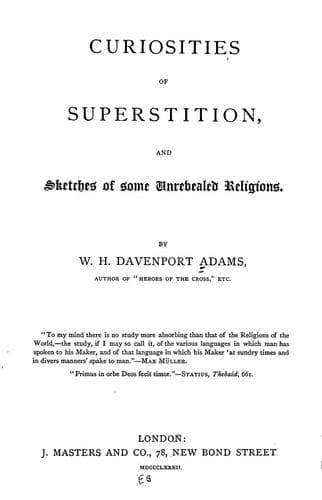
Curiosities of Superstition, and Sketches of Some Unrevealed ReligionsAdams, W. H. Davenport (William Henry Davenport)
Religion
Curiosities of Superstition, and Sketches of Some Unrevealed Religions
Adams, W. H. Davenport (William Henry Davenport)
Folklore; Religions; Superstition
The witch-finders, by their singing and dancing, had wrought themselves up
to a highly-excited and enthusiastic condition, so that they
unhesitatingly accepted the challenge, Nowamso crying, “Sing for me: make
a cadence for me.” Then, after a moment’s pause, she went on rapidly, in
her own language.
“Is this real? is it a test? is it but a show? Do the white chiefs want to
laugh at our pretensions? Has the white lady called us only to show other
white people that we can do nothing? Is anything really lost? is it not
hidden? No, it _is_ lost. Is it lost by a black person? No, a white person
has lost it. Is it lost by the great white chief? No, it is lost by an
ordinary white man. Let me see what it is that is lost. Is it money? No.
Is it a weighty thing? No, it can be always carried about--it is not
heavy. All people like to carry it, especially the white Inkosi: it is
made of the same metal as money. I could tell you more, but there is no
earnestness in all this,--it is only a spectacle.”
Between each of these ejaculations she made a pause, looking eagerly into
the faces of the men before her, who, for sole answer, gave a loud,
simultaneous snap of finger and thumb, pointing towards the ground as they
did so, and shouting the one word, “Yiz-ora,” (the first syllable strongly
accented and much prolonged;) “discover, reveal!” They can say nothing
more to urge her on, because they themselves are ignorant: but the weird
women watch their countenances eagerly, to detect, if they can, some
unconscious sign or token that their guesses are near the truth.
Suspecting a trick, Nowamso lapses into silence; but Nozilwane rushes
about like one possessed, sobbing and quivering with excitement, “It is
this--it is that!” The tall Nozinyanga strikes her lance firmly into the
ground, and cries haughtily, in her own tongue, “It is his watch!”
throwing around a haughty glance, as if daring any one to contradict her.
The others then join hands, and gallop round and round, making a
suggestion here and a suggestion there, all alike improbable; the
“inquirers,” as the kneeling men are called, affording them no assistance.
At last Nozilwane strikes home: “His pipe!” she exclaims; “Yoziva, yoziva,
a thing which has come off his pipe.”
And so it is. Nozilwane’s pluck, and perseverance, and cunning scrutiny of
our faces at each hit she made, have brought her off victoriously.
A murmur, or rather grunt, of admiration goes around. The “inquirers” jump
up, and “subside into ebony images of impassive respectability.” The weary
chorus disperses in small groups, and the exhausted sisterhood drop, as if
by one consent, on their knees, sitting back on their heels, and raise
their right hands in salutation.[43]
CHAPTER XI.
_ZABIANISM AND SERPENT-WORSHIP._
Public-domain text, read in full here on John Shaqi.
Reviews
Reviews
No reviews yet
Be the first to share your thoughts on this work.
Elsewhere in the archive
Join the Discussion
Join the discussion
Sign in to leave a comment or review.
Sign InorCreate an account