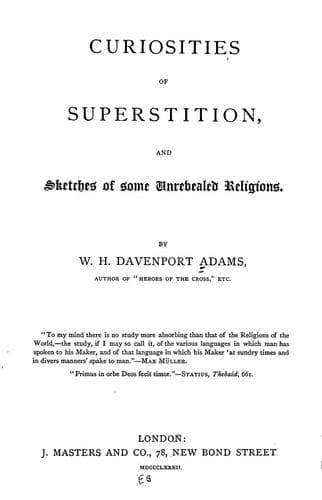
Curiosities of Superstition, and Sketches of Some Unrevealed ReligionsAdams, W. H. Davenport (William Henry Davenport)
Religion
Curiosities of Superstition, and Sketches of Some Unrevealed Religions
Adams, W. H. Davenport (William Henry Davenport)
Folklore; Religions; Superstition
Free from all animal desires, these spirits are created wholly for love
and harmony, for friendship and unity. They are unaffected by local and
temporal changes, and control the planetary spheres, without finding the
motion of the heaviest too heavy, or of the lightest too light. Their
never-ending existence is a prolonged happiness, owing to their nearness
to the Supreme GOD; whom they praise day and night, like the Angels, with
no sense of fatigue or satiety, and whose will they ever obey with the
keenest joy. Free agents, they are never inclined towards the evil. They
turn towards the good as readily as the flower towards the light.
Passing on to the cosmogonical part of the Zabian system, we find that it
is based on the existence of five primæval principles,--the Creator,
Reason, the Soul, Space, and the Void. These are the constituents of all
creation. But apart from these, or comprehending these, the Zabians seem
to have regarded two principles, GOD and the Soul, as specially active and
ever-living. Some writers represent them as believing also in a passive
principle, Matter; and in two principles which are neither living nor
passive, Time and Space. They appear to have regarded Matter as primeval
and everlasting, and to have ascribed to it the origin and duration of
Evil. GOD Himself created only the spheres, and the heavenly bodies which
they contain. These spheres (fathers) convey the types or ideas to the
elementary substances (mothers), and out of the combination, conjunction,
and motion of these spheres and elements are produced the various earthly
things (children). According to the Zabians, the world is renewed with
every “world-year,” or cycle, that is once every 36,425 ordinary years.
And at the close of each cycle, the life, vegetable, animal, and human
that had flourished within it cease to multiply, and new forms or types
spring into existence.
The vacillating and contending nature of man is due to the contradictory
elements of which he is composed. The desires and passions which sway him
to and fro, depress him to the low standard of the brute creation, and his
fall would be complete but for such religious rites as purifications,
sacrifices, and other means of grace. Through these he is able again to
draw near to the great gods, and to attain a resemblance unto them. The
human soul is dual, that is, it consists partly of the nature of the
animal soul and partly of that of the angelic soul. It is immortal, and
subject to future recompense and punishment, but not for ever, nor in any
world but this, though at different epochs of existence. Hence, our
present happiness is a reward for the good deeds done by us in an earlier
stage of existence; and our present suffering the just chastisement for
evil actions committed in the past. In its nature they hold that the soul
is primitive, because otherwise it must be material, and a material soul
is an impossibility.
Public-domain text, read in full here on John Shaqi.
Reviews
Reviews
No reviews yet
Be the first to share your thoughts on this work.
Elsewhere in the archive
Join the Discussion
Join the discussion
Sign in to leave a comment or review.
Sign InorCreate an account