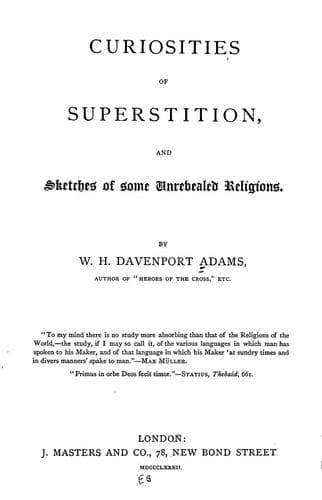
Curiosities of Superstition, and Sketches of Some Unrevealed ReligionsAdams, W. H. Davenport (William Henry Davenport)
Religion
Curiosities of Superstition, and Sketches of Some Unrevealed Religions
Adams, W. H. Davenport (William Henry Davenport)
Folklore; Religions; Superstition
“The soul,” says Kathibi, one of the Zabian teachers, “is thus immaterial,
and exists from eternity; is the involuntary reason of the first types, as
GOD is the First Cause of the Intelligences. Once on a time the soul
beheld matter and loved it. Glowing with the desire of assuming a bodily
shape, it would not again separate itself from that matter of which the
world was created. Since that time, the soul forgot itself, its
everlasting existence, its original abode, and knew nothing more of what
it had formerly known. But GOD, who converts all things to the best,
united it to matter, which it loved, and out of this union the heavens,
the elements, and other composite things arose. In order that the soul
might not wholly perish within matter, He endowed it with intelligence,
whereby it conceived its high origin, the spiritual world, and itself. It
further conceived through it that it was but a stranger in this world, in
which it was subject to many sufferings, and that even the joys of this
world are but the sources of new sufferings. As soon as the soul had
perceived all this, it began to yearn again for its spiritual home, as a
man who is away from his birthplace pines for his homestead. It then also
learned, that, in order to return to its primitive state, it had to shake
off the fetters of sensuous desires, and liberate itself from all
materialistic tendencies. Far from them all, it would once more regain its
heavenly sphere, and enjoy the bliss of the spiritual world.”[44]
Such is an outline of the religious system which flourished from the
middle of the ninth to the middle of the eleventh century, under the name
of Zabism.
Evidently, out of _this_ Zabaism Serpent-worship could not spring, because
it is of much greater antiquity. What then is the Zabism to which Bryant
alludes? A purely imaginary creed, which the mediæval, Jewish, Arabic, and
Persian writers identified with star-worship. The Mohammedan and other
writers of the twelfth century bestowed the name of Zabians indifferently
upon the ancient Chaldeans, the Buddhists, even the ante-Zoroastrian
Persians; and Bryant has followed their mistaken example. As a matter of
fact, Serpent-worship is a relic of nature-worship,--more particularly of
the old solar worship,--and the Serpent at first was unquestionably an
emblem of the Sun.
In Babylon large serpents of silver supported the image of the goddess
Rhea, in the temple of Bel, or Belus; and the name Bel itself is thought
by some writers to be an abbreviation of Ob-el, “the Serpent-God.” In the
Apocryphal book of Bel and the Dragon, we read: “In that same place there
was a great Dragon, which they of Babylon worshipped. And the king said
unto Daniel: Wilt thou say that this is of brass? lo, he eateth and
drinketh: thou canst not say he is no living god: therefore worship him.”
Public-domain text, read in full here on John Shaqi.
Reviews
Reviews
No reviews yet
Be the first to share your thoughts on this work.
Elsewhere in the archive
Join the Discussion
Join the discussion
Sign in to leave a comment or review.
Sign InorCreate an account