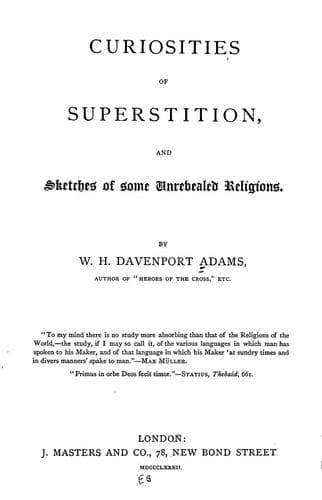
Curiosities of Superstition, and Sketches of Some Unrevealed ReligionsAdams, W. H. Davenport (William Henry Davenport)
Religion
Curiosities of Superstition, and Sketches of Some Unrevealed Religions
Adams, W. H. Davenport (William Henry Davenport)
Folklore; Religions; Superstition
In Argyllshire, near Oban, exists a huge serpent-shaped mound, discovered
by Mr. Phené in 1871, which must be mentioned in this connection. Looking
down upon it from the high ground to the westward, you see it rising
conspicuously from the flat grassy plain, which extends for some distance
on either side, with scarcely an undulation, save two artificial circular
mounds, in one of which lie several large stones forming a cromlech. A
recent visitor writes:
“Finding ourselves in the very presence of the Great Dragon, we hastened
to improve our acquaintance, and in a couple of minutes had scrambled on
to the ridge which forms his backbone, and thence perceived that we were
standing on an artificial mound three hundred feet in length, forming a
double curve like a huge letter S, and wonderfully perfect in anatomical
outline. This we perceived the more perfectly on reaching the head, which
lies at the western end, whence diverge small ridges, which may have
represented the paws of the reptile. On the head rests a circle of stones,
supposed to be emblematic of the solar disc, and exactly corresponding
with the solar circle as represented on the head of the mystic serpents of
Egypt and Phœnicia, and in the great American Serpent Mound. At the time
of Mr. Phené’s first visit to this spot there still remained in the centre
of this circle some traces of an altar, which, thanks to the depredations
of cattle and herd-boys, have since wholly disappeared....
“The circle was excavated on the 12th of October, 1871, and within it were
found three large stones, forming a chamber, which contained burnt human
bones, charcoal, and charred hazel-nuts. Surely the spirits of our Pagan
ancestors must rejoice to see how faithfully we, their descendants,
continue to burn our hazel-nuts on Hallow-e’en, their old autumnal Fire
Festival, though our modern divination is practised only with reference to
such a trivial matter as the faith of sweethearts! A flint was also found,
beautifully and minutely serrated at the edge; nevertheless, it was at
once evident, on opening the cairn, that the place had already been
ransacked, probably in secret, by treasure-seekers, as there is no
tradition of any excavation for scientific purposes having ever been made
here.
Public-domain text, read in full here on John Shaqi.
Reviews
Reviews
No reviews yet
Be the first to share your thoughts on this work.
Elsewhere in the archive
Join the Discussion
Join the discussion
Sign in to leave a comment or review.
Sign InorCreate an account