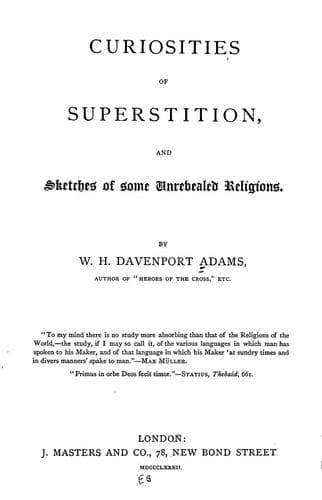
Curiosities of Superstition, and Sketches of Some Unrevealed ReligionsAdams, W. H. Davenport (William Henry Davenport)
Religion
Curiosities of Superstition, and Sketches of Some Unrevealed Religions
Adams, W. H. Davenport (William Henry Davenport)
Folklore; Religions; Superstition
“On the removal of the peat-moss and heather from the ridge of the
serpent’s back, it was found that the whole length of the spine was
carefully constructed with regularly and symmetrically placed stones, at
such an angle as to throw off rain; an adjustment to which we doubtless
owe the preservation, or at least the perfection, of this most remarkable
relic. To those who know how slow is the growth of peat-moss, even in damp
and undrained places, the depth to which it has here attained, though in a
dry and thoroughly exposed situation and raised from seventeen to twenty
feet above the level of the surrounding moss, tells of many a long century
of silent undisturbed growth, since the days when the serpent’s spine was
the well-worn path daily trodden by reverent feet. The spine is, in fact,
a long narrow causeway, made of large stones, set like the vertebræ of
some huge animal. They form a ridge sloping off in an angle at each side,
which is continued downwards with an arrangement of smaller stones,
suggestive of ribs.”
This strange memorial of a departed age and a vanished faith, lying in the
silence and solitude of the lonely shore of Loch Nell, recalls to mind
the eloquent lines of an American poet:[46]
“All desolate their ruins rest,
Like bark that in mid-ocean rolls,
Her name effaced, her masts o’erthrown,
And none remaining of the souls
That once sailed in her, to relate
From what far distant port she came;
Whither she sailed and what her fate,
And what her nation and her name.
But only may conjecture guess
The fancied story of this place,
And from these crumbling ruins gain
Some knowledge of the vanished race.”
It must be noticed that the serpent-mound has been so disposed that the
worshipper standing at the altar would naturally look eastward, directly
along the whole length of the great reptile, and across the dark lake, to
the threefold peaks of Ben Cruachan. That this position was intentionally
selected is evident from the fact that the three peaks are visible from no
other point.
And hence arises the not wholly fanciful conjecture that the people who
erected the great mound had some dim idea of the Triune character of GOD.
The serpent was the emblem of His wisdom, as the solar circle was of His
Eternal Unity; and this marked reverence for the triple-peaked mountain
seems to indicate that with a knowledge of His unity was combined a
recognition of His threefold manifestation.
Public-domain text, read in full here on John Shaqi.
Reviews
Reviews
No reviews yet
Be the first to share your thoughts on this work.
Elsewhere in the archive
Join the Discussion
Join the discussion
Sign in to leave a comment or review.
Sign InorCreate an account