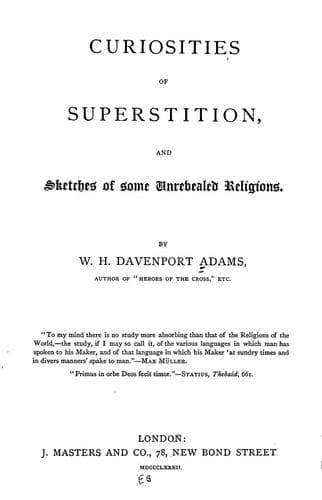
Curiosities of Superstition, and Sketches of Some Unrevealed ReligionsAdams, W. H. Davenport (William Henry Davenport)
Religion
Curiosities of Superstition, and Sketches of Some Unrevealed Religions
Adams, W. H. Davenport (William Henry Davenport)
Folklore; Religions; Superstition
It is curious to find proofs of the existence of Serpent-worship in the
New World as in the Old; to meet with its traces in Mexico as well as in
Egypt or Chaldea. But certain it is that the religion of Mexico had many
features which were common to the Egyptian and Chaldean creeds; the same
Solar Worship, the same pyramidal monuments, and the same Ophiolatrous
symbols.
For instance, we learn that the temple of Huitziliputli, in Mexico, was
built of great stones, in the fashion of snakes tied one to another, and
that the circuit was called “the circuit of snakes,” because the walls of
the enclosure were covered with the figures of snakes. This
truculent-looking deity held in his right hand a staff cut in the fashion
of a serpent; and the four corners of the ark or tabernacle, in which he
was seated, terminated each with a carved effigy of a serpent’s head.
The Mexican astronomers represented a century by a circle, with a sun in
the centre, surrounded by the symbols of the years. The circumference was
a serpent twisted into four knots at the cardinal points.
The Mexican month was divided into twenty days, two of which were
symbolised by the serpent and dragon. Further, the doorway of the temple,
dedicated to “the god of the air,” was so wrought as to resemble a
serpent’s mouth.
The Mexicans, however, went beyond the _symbolical_ worship of the sacred
serpent, and like many other branches of the Ophite family, they fostered
living serpents in their dwellings as household gods. Mr. Bullock asserts
that they make the rattlesnake an object of their worship and veneration;
and that representations of this reptile, and of others of its species,
are very commonly met with among the remains of their ancient idolatry. He
says that the finest known to be in existence may be seen in a deserted
part of the cloister of the Dominican convent, opposite to the Palace of
the Inquisition. It is curled up in an irritated, erect position, with the
jaws extended, and is represented in the act of gorging a woman, richly
dressed, who lies between its fangs, crushed and lacerated.
Public-domain text, read in full here on John Shaqi.
Reviews
Reviews
No reviews yet
Be the first to share your thoughts on this work.
Elsewhere in the archive
Join the Discussion
Join the discussion
Sign in to leave a comment or review.
Sign InorCreate an account