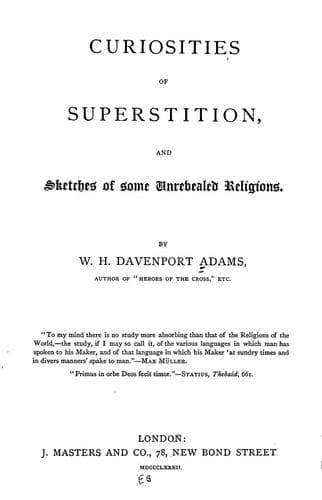
Curiosities of Superstition, and Sketches of Some Unrevealed ReligionsAdams, W. H. Davenport (William Henry Davenport)
Religion
Curiosities of Superstition, and Sketches of Some Unrevealed Religions
Adams, W. H. Davenport (William Henry Davenport)
Folklore; Religions; Superstition
It is curious that at Erdeven, where the temple begins, an annual dance,
descriptive of the Ophite hierogram of the circle and serpent, is still
celebrated by the peasants at the Carnival. But the only tradition which
survives respecting the stones is one which lingers in various parts of
England where similar memorials are found, that they were originally
endowed with life, and were petrified as they stand. Some of the Bretons
believe they were the Roman army who pursued the centurion Cornelius on
account of his conversion to Christianity, and were stricken into stone
through his prayers. Others imagine that certain supernatural dwarfs
erected them in a single night, and that each still inhabits the stone he
reared.
Mr. Deane tells us that near the Karnak side of the dracontium rises a
singular mound of great elevation, which has once been conical, and the
upper portion of which is evidently artificial.[47] He regards it as
analogous to the remarkable hill of Silbury, which occupies much the same
position towards the Albury dracontium. Probably these mounds served as
altars, on which, in conformity with the practices of the Solar worship,
was kept burning the perpetual fire kindled by the sun. They are of common
occurrence in Persia, and seem to be identical with “the high places” of
Scripture where the priests of Baal celebrated their sacrifices. The
conical mound near Karnak--which may be seen for miles around--has been
consecrated by the Christians to the Archangel Michael, who is the patron
saint of every height, hill, or cone, natural or artificial, in Brittany.
The reason of this dedication has been conjectured to be that S. Michael
is the assailant and conqueror of the spiritual Dragon of the Apocalypse.
The mutilated image of that great serpent lies prostrate below the mound;
and when its worshippers were converted to the religion of CHRIST, they
naturally erected on the Solar mount a chapel consecrated to its
archangelic slayer. This consecration indicates, therefore, the triumph of
Christianity over Ophiolatry; and it is but consistent, says Deane, that
the people who allegorised the conversion of the Ophites by the metaphor
of a victory over _serpents_, should, in token of the victory, erect upon
the high places of idolatry chapels to the great Archangel.
It is possible that the mound gave name to the adjacent village: that is,
Karn-ak, or Carnac, from “_cairn_” a hill, and “_hac_,” a snake. The
“serpent’s hill” would be no unsuitable title for Mont S. Michel. In the
same manner the group of pillars called _Lemaenac_, may have been named
from _maen_, stones, and _hac_.
Public-domain text, read in full here on John Shaqi.
Reviews
Reviews
No reviews yet
Be the first to share your thoughts on this work.
Elsewhere in the archive
Join the Discussion
Join the discussion
Sign in to leave a comment or review.
Sign InorCreate an account