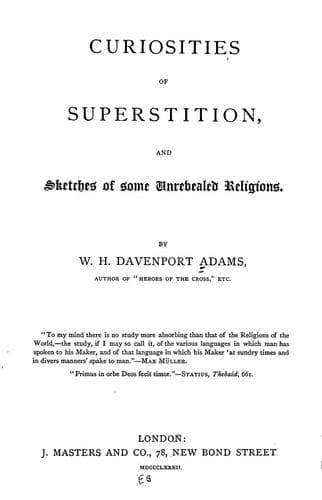
Curiosities of Superstition, and Sketches of Some Unrevealed ReligionsAdams, W. H. Davenport (William Henry Davenport)
Religion
Curiosities of Superstition, and Sketches of Some Unrevealed Religions
Adams, W. H. Davenport (William Henry Davenport)
Folklore; Religions; Superstition
“The only worship,” says Mr. Deane,[48] “which can vie with that of the
Serpent in antiquity or universality, is the adoration of the SUN. But
uniformly with the progress of the Solar superstitions has advanced the
sacred serpent from Babylon to Peru. If the worship of the Sun, therefore,
was the first deviation from the truth, the worship of the Serpent was one
of the first innovations of idolatry. Whatever doubt may exist as to which
was the first error, little doubt can arise as to the primitive and
antediluvian character of both. For in the earliest heathen records we
find them inexplicably interwoven as the first of superstitions. Thus
Egyptian mythology informs us, that Helios (the Sun) was the first of the
Egyptian gods; for in early history, kings and gods are generally
confounded. But Helios married Ops, the serpent deity, and became father
of Osiris, Isis, Typhœus, Apollo, and Venus: a tradition which would make
the superstitions coeval. This fable being reduced to more simple laws,
informs us, that the Sun, having married the Serpent, became, by this
union, the father of Adam and Eve, the Evil Spirit, the Serpent-solar
deity, and Lust; which appears to be a confusion of Scriptural truths, in
which chronological order is sacrificed from the simplification of a
fable. But--_ex pede Herculem_--from the small fragments of the truth
which are here combined, we may judge of the original dimensions of the
knowledge whose ruins are thus heaped together. We may conclude that,
since idolatry, lust, the serpent, and the evil spirit, are here said to
have been synchronous with the First Man and Woman, the whole fable is
little more than a mythological version of the events in Paradise.”
Mr. Deane, who lived before the days of Comparative Mythology, read into
the old fables a meaning which they are hardly capable of bearing. It is
clear enough that Serpent-worship had an astronomical origin; but we may
agree with him that it was as ancient and universal as the worship of the
Sun, with which, indeed, it was closely connected.
* * * * *
We shall now borrow a few illustrations of the character, extent, and
significance of Serpent-worship from Mr. Fergusson’s elaborate work,[49]
in which he deals particularly with the Topes at Sanchi and Amravati. But,
first, a word or two in explanation of the origin and purpose of the Topes
will be desirable.
The era of stone architecture in India seems to have begun with the reign
of Asoka about 250 B.C. It is contemporaneous with the rise of Buddhism,
whose followers gradually usurped the place formerly occupied by the
Aryans. The Buddhist buildings then erected may be divided into three
principal classes:
1st. _Topes_ or _Stupas_, with their surrounding rails and lats:
2nd. _Chaityas_, which, in form and purpose, closely resemble the early
Churches of the Christians, though several of those cut in the rock were,
in all probability, excavated before the Christian era: and,
Public-domain text, read in full here on John Shaqi.
Reviews
Reviews
No reviews yet
Be the first to share your thoughts on this work.
Elsewhere in the archive
Join the Discussion
Join the discussion
Sign in to leave a comment or review.
Sign InorCreate an account