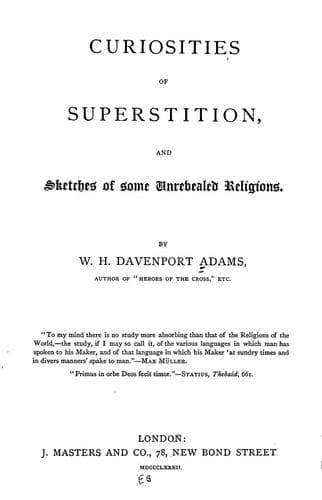
Curiosities of Superstition, and Sketches of Some Unrevealed ReligionsAdams, W. H. Davenport (William Henry Davenport)
Religion
Curiosities of Superstition, and Sketches of Some Unrevealed Religions
Adams, W. H. Davenport (William Henry Davenport)
Folklore; Religions; Superstition
3rd. _Viharas_, or Monasteries, forming in the earliest times the
dwellings of the monks or priests who ministered in the Topes or Chaityas,
but afterwards becoming the independent abode of monastic communities, who
had chapels or oratories appropriated to their use within the walls of
their monasteries.
We are here concerned only with the Tope or Stupa.
In its origin we suspect that it simply took the place of the mound or
tumulus which the Turanian and other races had from earliest ages been
accustomed to raise over the last resting-place of their dead. No such
tumuli now exist in India, having probably been washed away by the
tropical rains or river-floods; but some are still found in Afghanistan.
The Indian type is distinguished from the tumulus of other countries by
its material and its shape. It is built of brick or stone, in a rounded or
conical form. It is distinguished also by the circumstance that instead of
being the place of interment of a corpse, it is the depository of relics.
Besides being used as a relic-shrine, the Tope was frequently employed as
a memorial tower to indicate a sacred spot. Of the 84,000 Stupas which,
according to tradition, Asoka erected, fully one half would seem to have
been raised to mark the scenes where Buddha or some Bôdhisatwa had
performed a miracle or done something worthy of being remembered by the
faithful.
The “rails,” or stone-circles, surrounding the Indian Topes are often of
as much importance as the Topes themselves; and in the case of Sanchi and
Amravati, are even _more_ important. As with the Topes, they are
sepulchral in origin. “The circles of rude stones found all over Europe
certainly are so in most cases. They may sometimes enclose holy spots, and
may possibly have in some instances places of assembly, though this is
improbable. Their application to the purposes of ancestral worship is,
however, not only probable, but appropriate. Sometimes a circle of stones
encloses a sepulchral mound, as at New Grange in Ireland, and very
frequently in Scandinavia and Algeria. In India rude stone circles are of
frequent occurrence.” Some hundreds are found in the neighbourhood of
Amravati alone, and all are sepulchral; but like the Topes when adopted by
the Buddhists, they were “sublimated into a symbol instead of a reality.”
Public-domain text, read in full here on John Shaqi.
Reviews
Reviews
No reviews yet
Be the first to share your thoughts on this work.
Elsewhere in the archive
Join the Discussion
Join the discussion
Sign in to leave a comment or review.
Sign InorCreate an account