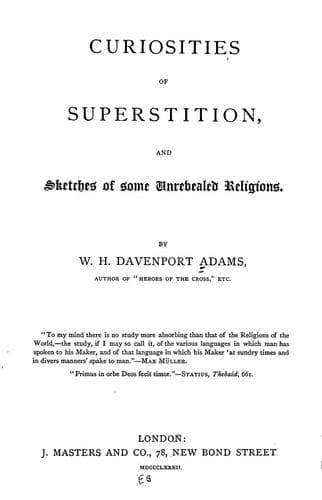
Curiosities of Superstition, and Sketches of Some Unrevealed ReligionsAdams, W. H. Davenport (William Henry Davenport)
Religion
Curiosities of Superstition, and Sketches of Some Unrevealed Religions
Adams, W. H. Davenport (William Henry Davenport)
Folklore; Religions; Superstition
The human figures represented in these sculptures belong in the main to
two great races. One of them is easily recognised as “Hindus,”--“meaning
by that term the civilized race who formerly occupied the valley of the
Ganges, and who, from their capitals of Ayodhyâ and Indraprastha or
Pâtaliputra (Palibothra), had been the dominant class in India for at
least two thousand years before the time to which we are now referring.”
It may be taken as proved that these people were originally pure
immigrant Aryans, but by intermixture with other races their blood took,
as it were, a new colouring, though they did not lose the civilisation and
pre-eminence which they owed to their intellectual superiority.
We know them in the sculptures by their costume; by the dhoti, wrapped
round the loins exactly as it is worn now-a-days; the chadder over their
shoulders; and the turban on their heads. So much for the dress of the
men; of the undress of the women it is more difficult to speak. They are
always decorated with enormous bangles about the wrists and ankles, and
strings of beads round the neck; but with the exception of a bead belt
round the body below the waist they wear little body clothing. From this
belt slips of cloth are sometimes suspended, more generally at the sides
or behind than in front,--and sometimes also a cloth not unlike a dhoti,
invariably of transparent texture. This scantiness of attire can hardly be
regarded as finding compensation in the dimensions and amplitude of the
head-dress, which, consisting of two long plaits of hair mixed with beads,
and a thick roll of cloth, forms almost a kind of tippet, covering the
whole of the woman’s back.
Mr. Fergusson remarks:[50]
“It is, however, not only in the Topes that this absence of dress is so
conspicuous. In all the sculptures at Karli, or Ellora, or Mahavellipore,
or in the paintings in Ajanta, the same peculiarity is observable.
Everywhere, indeed, before the Mahometan conquest, nudity in India
conveyed no sense of indecency. The wife and mother of Buddha are at times
represented in this manner. The queen on her throne, the female disciples
of Buddha, listening to his exhortations, and on every public occasion on
which women take part in what is going on, the costume is the same. It is
equally remarkable that in those days those unveiled females seem to have
taken part in every public transaction and show, and to have mixed with
the men as freely as women do in Europe at the present day.
Public-domain text, read in full here on John Shaqi.
Reviews
Reviews
No reviews yet
Be the first to share your thoughts on this work.
Elsewhere in the archive
Join the Discussion
Join the discussion
Sign in to leave a comment or review.
Sign InorCreate an account