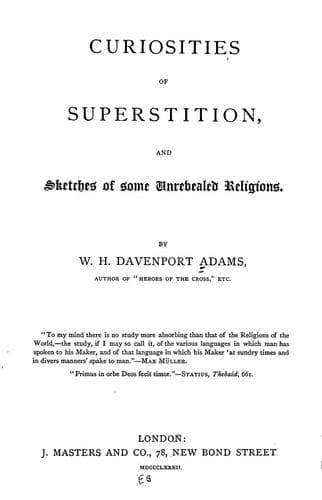
Curiosities of Superstition, and Sketches of Some Unrevealed ReligionsAdams, W. H. Davenport (William Henry Davenport)
Religion
Curiosities of Superstition, and Sketches of Some Unrevealed Religions
Adams, W. H. Davenport (William Henry Davenport)
Folklore; Religions; Superstition
“All this is the more remarkable, as in Buddhist books modesty of dress in
women is frequently insisted upon. In the Dulva, for instance, a story is
told of the King of Kalinga presenting to the King of Kosála (probably
Padh), a piece of muslin, which afterwards fell into the hands of a lewd
priestess. She, it is said, wore it in public, while it was so thin that
she, notwithstanding this, appeared naked to the great scandal of all who
witnessed the exhibition.[51] The probability is, that the story and the
book that contains it are of very much more modern date than our
sculptures. It certainly is in direct conflict with their evidence.”
The want of shame in women, to which this exposure of the person bears
witness, is always the mark and sign of inferior civilisation.
The other race depicted in the sculptures has its distinctive
characteristics. The male costume consists of a kilt,--not a cloth wrapped
round the loins, but a kilt, shaped, sewn, and fastened by buckle or
string;--and also of a cloak or tippet, which seems to be similarly shaped
and sewn. As for the hair, it is twisted into a long rope or plait like a
Chinaman’s, and then folded round the head in a conical form, or a piece
of cloth or rope was treated in this way. The beard is worn, whereas no
single individual of the Hindu race, either at Sanchi or Amravati, has any
trace of beard or moustache; a circumstance the more remarkable, because,
according to Nearchus, the Hindus dyed their beards with various colours,
so that some were red, some white, some black, others purple, some green.
The female dress differs from that of the Hindus even more than the male.
A striped petticoat is gathered in at the knees so as to form a neat and
modest garb, and a cloak or tippet like that of the men is thrown
generally over one shoulder so as to leave one breast bare, but sometimes
both are covered. The head-dress is a neat and elegant turban.
Public-domain text, read in full here on John Shaqi.
Reviews
Reviews
No reviews yet
Be the first to share your thoughts on this work.
Elsewhere in the archive
Join the Discussion
Join the discussion
Sign in to leave a comment or review.
Sign InorCreate an account