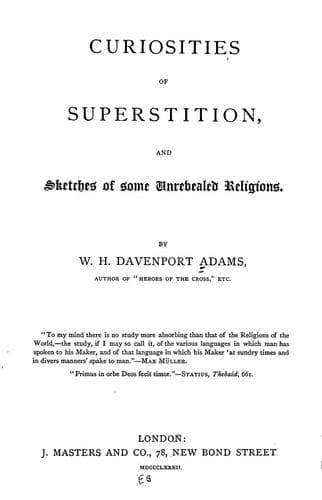
Curiosities of Superstition, and Sketches of Some Unrevealed ReligionsAdams, W. H. Davenport (William Henry Davenport)
Religion
Curiosities of Superstition, and Sketches of Some Unrevealed Religions
Adams, W. H. Davenport (William Henry Davenport)
Folklore; Religions; Superstition
In the centre of the bas-relief sits the principal personage, with a
nine-headed snake-hood, between two of his wives, and beyond, on both rims
of the circle, stands a female figure, supporting herself by the branches
of a tree. On each a young girl waits; one of these girls has a snake at
the back of her head. In front are three musicians, also with snakes; and
on their right a lady _without_ a snake receives the assistance of a girl
_with_ a snake.
“This distinction,” says Mr. Fergusson, “between people with snakes and
those without is most curious and perplexing. After the most attentive
study I have been unable to detect any characteristic either of feature or
costume by which the races can be distinguished, beyond the possession or
absence of this strange adjunct. That those with snakes are the Naga
people we read of, can hardly be doubted; yet they never are seen actually
worshipping the snake like the Dasyus, but rather as protected by it. The
snake seems their tutelary genius, watching over, perhaps inspiring them;
but whether they borrowed this strange emblem from the natives of the
country, or brought it with them from the north-west, are questions we are
hardly yet in a position to answer satisfactorily.”
* * * * *
We have thus abundant evidence of the prevalence of Serpent-worship in
India in “olden times;” the reader will, perhaps, be surprised to hear
that it lingers still throughout the peninsula. Dr. Balfour, who had an
intimate acquaintance with the habits and customs of the natives, asserts
that the worship both of the sculptured form and the living creature, is
general. The sculpture invariably represents the Nag or Cobra, and almost
every hamlet owns its Serpent deity. Sometimes it is a single snake, with
the hood spread open. Occasionally the sculptured figures are nine in
number, forming the _Nao Nag_, which is designed to represent a parent
snake and eight of its young, but the prevalent form is that of two snakes
twining in the manner of the Esculapian rod of classical antiquity.
Public-domain text, read in full here on John Shaqi.
Reviews
Reviews
No reviews yet
Be the first to share your thoughts on this work.
Elsewhere in the archive
Join the Discussion
Join the discussion
Sign in to leave a comment or review.
Sign InorCreate an account