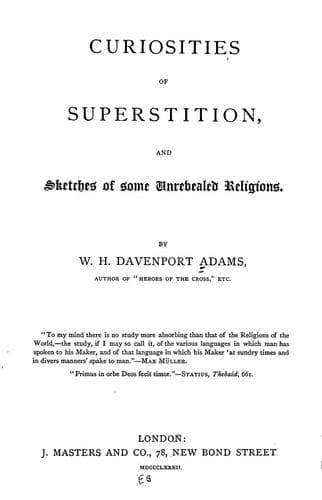
Curiosities of Superstition, and Sketches of Some Unrevealed ReligionsAdams, W. H. Davenport (William Henry Davenport)
Religion
Curiosities of Superstition, and Sketches of Some Unrevealed Religions
Adams, W. H. Davenport (William Henry Davenport)
Folklore; Religions; Superstition
It is the opinion of some Hindus that the living snake is not worshipped
as a devata, or deity, but simply reverenced in commemoration of some
ancient event--possibly of some astronomical occurrences. Others, however,
distinctly assert that it is worshipped as a devata. However this may be,
there can be no doubt that the living snake is worshipped throughout all
Southern India. On their feast days the worshippers resort to the snake’s
lair, which they bedaub with vermilion streaks and patches of turmeric and
of wheat flour, and close at hand they suspend garlands of flowers, strung
upon white cotton thread, and laid over wooden frames. During the rainy
seasons occurs the great Nagpanchanic festival, when the Hindus go in
search of snakes, or have them brought to their houses by the Sanpeli, the
snake-charmers who ensnare them. The snakes are then worshipped, and
offerings of milk are made to them, and in almost every house figures of
snakes, drawn on paper, are affixed to the walls, and worshipped. Those
who visit the snakes’ abodes, or tents, plant sticks around the hole, and
about and over these sticks wind white cotton thread. A bevy of Mahrathi
women repair to the hût, and joining hands, wind round it in a circle five
times, singing songs; after which they prostrate themselves. They pour
milk into the hole; hang festoons of Chembela flowers and cucumber fruit,
and sprinkle a mixture of sugar and flour.
In reference to this festival, Colonel Meadows Taylor writes:--
On this occasion, Nags or Cobras are worshipped by most of the lower
classes of the people in the Dekhan, and more particularly in the
Shorapore country. The ceremonies are very simple: the worshippers bathe,
smear their foreheads with red colour, and in small parties,--generally
families acquainted with one another,--resort to the places known to be
frequented by snakes. In such places there are generally sacred stones, to
which various offerings are made, and they are anointed with red colour
and ground turmeric, and invocations are addressed to the local genius and
to the serpents. Near the stones are placed small new earthen saucers,
filled with milk; for cobras are fond of milk, and are believed to watch
the ceremony, coming out of their holes and drinking the milk, even while
the worshippers are near, or are lingering in the distance to see if their
offerings be received. It is considered a fortunate augury for the
worshippers if the snake should appear and drink. Should the snake _not_
appear, the worshippers, after waiting awhile, return to the place next
morning, to ascertain the result: if the milk have disappeared, the rite
has been accepted, but not under such favourable auspices as if the
reptile had come out at once. These ceremonies end with a feast.
Colonel Meadows Taylor (whose language we are partly adopting)
continues:--
Public-domain text, read in full here on John Shaqi.
Reviews
Reviews
No reviews yet
Be the first to share your thoughts on this work.
Elsewhere in the archive
Join the Discussion
Join the discussion
Sign in to leave a comment or review.
Sign InorCreate an account