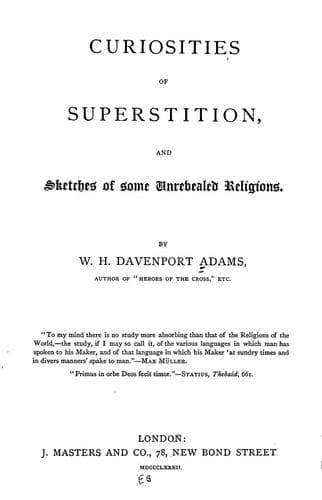
Curiosities of Superstition, and Sketches of Some Unrevealed ReligionsAdams, W. H. Davenport (William Henry Davenport)
Religion
Curiosities of Superstition, and Sketches of Some Unrevealed Religions
Adams, W. H. Davenport (William Henry Davenport)
Folklore; Religions; Superstition
A rod, with snares at the end, made of the fibres of the cocoa-nut husk,
with which the priest caught the spirit of the god. It was used in cases
of pregnancy, when the female was ambitious that her child should be a
son, and become a famous warrior. It was also employed in wartime to catch
the god by his leg, to secure his influence on the side of the party
performing the ceremony.
Ruanu; a chief from Raiatea, who, ages ago, sailed in a canoe from that
island, and settled at Aitutaki. From him a genealogy is traced. He died
at Aitutaki, and was deified as _Te atua taitai tere_, or the conductor of
fleets.
Tanu; with his fan and other appendages; the god of thunder. The natives,
when they heard a peal of thunder, were accustomed to say that this god
was flying: and produced this sound by the flapping of his wings.
The Rarotongan idols were of a singular character. From their size they
might have suited Swift’s nation of Brobdingnagians, for the smallest
seems to have been about fifteen feet high. Each was wrought out of a
piece of _aito_, or iron wood, about four inches in diameter, carved with
a rude imitation of the human hand at one end, and with an obscene figure
at the other; round it were wrapped numerous folds of native cloth, until
it measured two or three yards in circumference. Near the wooden image
some red feathers were strewn, and a string of small pieces of polished
pearl shells was regarded as the _manava_, or soul of the god.
An idol, somewhat resembling a Chinese joss, was placed in the fore-part
of every fishing-canoe; and prior to their departure on a fishing
excursion, the boatmen aways presented it with offerings, and invoked it
to grant them a successful issue.
A striking scene was that when Papeiha, a converted islander, lifted up
his voice against idolatry, for the first time, among the banana-groves of
Rarotonga.
The Rarotongans had assembled in great numbers at a _marae_, or sacred
enclosure, for the purpose of making offerings of food to the gods. Many
priests, pretending to be inspired, were filling the air with shouts and
yells; whilst around them gathered the deluded worshippers, some with one
side of their face and body blackened with charcoal; others were painted
with stripes of various colours; others figured as warriors, wearing large
caps adorned with white cowrie shells and birds’ feathers. Breaking into
their midst, Papeiha boldly addressed them on their folly in devoting such
large quantities of food to a log of wood which they had carved and
decorated and called a god. This challenge was immediately accepted by one
of the priests, who springing to his feet, protested that their god was a
real god, and a very powerful god, and that they were that day celebrating
a very sacred feast.
Public-domain text, read in full here on John Shaqi.
Reviews
Reviews
No reviews yet
Be the first to share your thoughts on this work.
Elsewhere in the archive
Join the Discussion
Join the discussion
Sign in to leave a comment or review.
Sign InorCreate an account