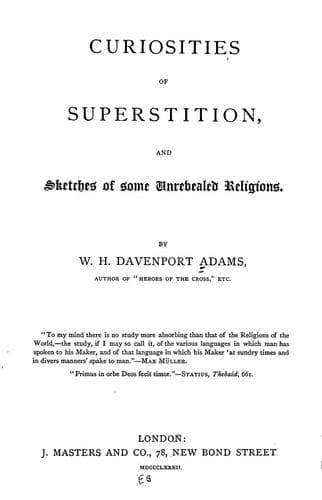
Curiosities of Superstition, and Sketches of Some Unrevealed ReligionsAdams, W. H. Davenport (William Henry Davenport)
Religion
Curiosities of Superstition, and Sketches of Some Unrevealed Religions
Adams, W. H. Davenport (William Henry Davenport)
Folklore; Religions; Superstition
“In reference to the lower castes alluded to, I may mention those who
practise Snake-worship with the greatest reverence:--1, Beydars. 2,
Dhungars or shepherds, Ahens or milkmen, Waddiwars or stone-masons,
Khungins or rope-makers, Brinjaras and other wandering tribes, Mangs,
Dhérs, and Chennars, Ramorsers, Bhils, Ghonds, and Kohs, all which I
believe, with many others, to be descendants of aboriginal tribes, partly
received within the pale of Hinduism.
“Lingayots, who are schismatics from Hinduism, and who deny _in toto_ the
religious supremacy of the Brahmins, are nevertheless Snake-worshippers,
many of them bearing the name Nag, both male and female.
“I cannot speak of the North of India, but in the whole of the South of
India, from the Nerbudda to Cape Comorin, Snake-worship is now
existent.”[53]
CHAPTER XII.
_POLYNESIAN SUPERSTITIONS._
When Captain Cook first visited those beautiful islands of the South
Pacific which are now included under the general name of Polynesia, he
found their inhabitants given over to the lowest and coarsest idolatry.
Many of their rites and ceremonies were as lewd as any practised in
ancient times under the auspices of the Paphian Venus. Gradually they were
brought within the influence of the missionary work of the Christian
Church; and though, if we may credit the testimony of recent observers,
much heathenism still prevails, and gross superstitions are still secretly
nourished, there cannot be a doubt, that, on the whole, their moral
condition has been materially elevated.
Among the pioneers of the Cross in these “Summer-isles of Eden” one of the
most eminent and successful was the Rev. John Williams; a missionary of
the true type, of an enlightened mind and broad sympathies, who, after a
long career of noble labour, sealed his witness to the truth with his
blood, and lives in the Gospel record as the Martyr of Erromanga. From the
plain, unvarnished, and effective chronicle of his “Missionary
Enterprises” we glean much interesting information respecting the
idolatrous ways of the islanders, revealing their identity with the
superstitions that from all times have dominated over uncivilised man. In
Rarotonga as in Mexico, for instance, the gods were supposed to be
propitiated by human sacrifices; and in many of the islands cannibalism
existed in its most disgusting form and under the sanction of a religious
ordinance.
From the chief of Aitutaki Mr. Williams obtained some curious relics of
idolatry. As for example:--an idol named _Te-rongo_, one of the great
deities, called a _Kaitangata_, or man-eater. The priests of this idol
were supposed to be inspired by the shark.
Tangarou, the great national god of Aitutaki, and of almost all the
adjacent islands. He holds the net with which he catches the spirits of
men as they fly from their bodies, and a spear with which he kills them.
Public-domain text, read in full here on John Shaqi.
Reviews
Reviews
No reviews yet
Be the first to share your thoughts on this work.
Elsewhere in the archive
Join the Discussion
Join the discussion
Sign in to leave a comment or review.
Sign InorCreate an account