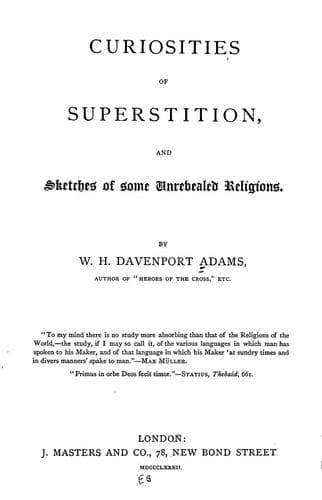
Curiosities of Superstition, and Sketches of Some Unrevealed ReligionsAdams, W. H. Davenport (William Henry Davenport)
Religion
Curiosities of Superstition, and Sketches of Some Unrevealed Religions
Adams, W. H. Davenport (William Henry Davenport)
Folklore; Religions; Superstition
The religious system of the Samoans, according to Mr. Williams, differed
in essential respects from that which prevailed at the Tahitian, Society,
and other Polynesian groups. They had neither maraes nor temples, nor
altars nor offerings; and consequently none of the barbarous and
sanguinary rites to which we have alluded. They shed no human blood; they
strewed no maraes with the skulls and bones of their victims; they
dedicated no sacred groves to brutal and sensual observances. Hence the
Rarotongans denounced them for their impiety, and “a godless Samoan” was a
proverbial phrase. Yet they were not without their superstitions; they had
lords many and gods many; and their credulity was as marked as that of any
other savage race on whom the light of Christianity and civilisation had
never shone.
In considering the religion of the Polynesians, there are four points to
be glanced at; 1, their gods; 2, their cultus; 3, their ideas of
immortality; and 4, the means by which they hoped to secure future
happiness.
1. Their gods consisted of three kinds: their deified ancestors, their
idols, and their etus.
Some of their ancestors were deified, after the Greek fashion, for the
supposed boons they had conferred upon mankind. For example, it was
believed that the world was formerly in darkness; but that the sun, moon,
and stars were created by one of their progenitors in a manner too absurd
to be described. Also, that the heavens were of old so close to the earth
that men could not walk erect, and were compelled to crawl; until a great
man conceived the idea of elevating them to their present height; which he
effected by the employment of almost Herculean energy. By his first effort
he raised them to the top of a tender plant, called _teve_, about four
feet high. There they remained until he had refreshed and rested himself.
A second effort, and he upheaved them to the height of a tree called
_kanariki_, which is as tall as the sycamore. His third attempt carried
them to the summits of the mountains; and after a long period of repose,
and another tremendous struggle, he raised them to their present altitude,
at which they have ever since remained. This wonderful personage was
appropriately apotheosized; and down to the date of the introduction of
Christianity, was everywhere worshipped as “the Elevator of the Heavens.”
Public-domain text, read in full here on John Shaqi.
Reviews
Reviews
No reviews yet
Be the first to share your thoughts on this work.
Elsewhere in the archive
Join the Discussion
Join the discussion
Sign in to leave a comment or review.
Sign InorCreate an account