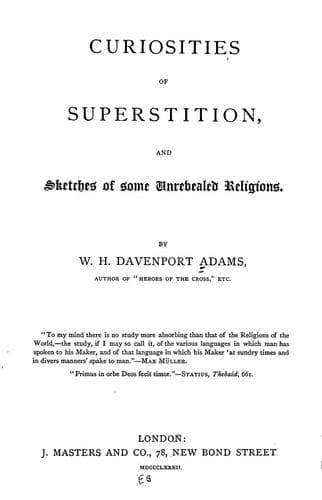
Curiosities of Superstition, and Sketches of Some Unrevealed ReligionsAdams, W. H. Davenport (William Henry Davenport)
Religion
Curiosities of Superstition, and Sketches of Some Unrevealed Religions
Adams, W. H. Davenport (William Henry Davenport)
Folklore; Religions; Superstition
The fisherman had his god; so had the husbandman, the voyager, the
warrior, the thief; mothers dedicated their offspring to one or other of
these numerous Powers, and chiefly to Hero, the god of thieves, and to
Oro, the god of war. “If to the former, the mother, while pregnant, went
to the marae with the requisite offerings, when the priest performed the
ceremony of catching the spirit of the god with the snare previously
described, and infusing it into the child even prior to its birth, that it
might become a clever and desperate thief. Most parents, however, were
anxious that their children should become brave and renowned warriors.
This appears to have been the very summit of a heathen mother’s ambition,
and to secure it, numerous ceremonies were performed before the child was
born; and after its birth it was taken to the marae, and formally
dedicated to Oro. The spirit of the god was then caught, and imparted to
the infant, and the ceremony was completed by numerous offerings and
prayers. At New Zealand, stones were thrust down the throat of the babe,
to give it a stony heart, and make it a dauntless and desperate warrior.”
This dedication of the child to the sanguinary war-god points to a
condition of society in which life was verily and indeed a battle, and
every one had to hold his own by right of a strong arm and a reckless
spirit. There was no room for the feeble in such a system; they crawled
aside to die; or were trampled to death in the rush and press of the
crowd. Civilisation has its victims; but assuredly they are few in
comparison to the thousands and tens of thousands destroyed by the
merciless tyranny of Heathenism. Civilisation does at least teach us our
duties towards our neighbours; while Savage Man had little sentiment of
compassion or affection for father or brother, daughter or wife.
The second class of objects regarded with religious veneration was
_Idols_. In every island and district these were different; but in every
island and district they abounded. Some were large, some small; some
hideous in the extreme, others were almost comely. No fixed pattern
appears to have been before the idol-makers; each man followed his own
fancy.
The third object of worship was the _Etu_,--that is, some bird, fish, or
reptile, in which the natives believed that a spirit resided. This form of
idolatry was more in vogue in the Samoas than in any other island-group.
Among the Samoans, the objects regarded as _etus_ were, indeed, almost
innumerable, and frequently they were of extraordinary triviality. It was
not unusual to see a chief, in other matters really intelligent, muttering
his prayers to a fly, an ant, or a lizard, if such chanced to crawl or
alight in his presence.
Public-domain text, read in full here on John Shaqi.
Reviews
Reviews
No reviews yet
Be the first to share your thoughts on this work.
Elsewhere in the archive
Join the Discussion
Join the discussion
Sign in to leave a comment or review.
Sign InorCreate an account