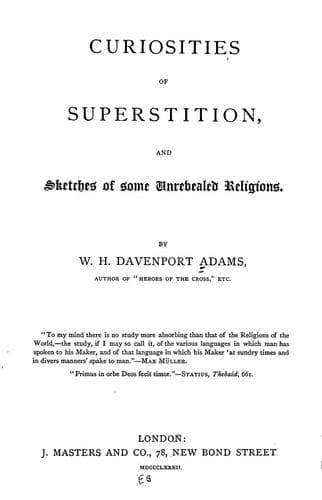
Curiosities of Superstition, and Sketches of Some Unrevealed ReligionsAdams, W. H. Davenport (William Henry Davenport)
Religion
Curiosities of Superstition, and Sketches of Some Unrevealed Religions
Adams, W. H. Davenport (William Henry Davenport)
Folklore; Religions; Superstition
their savage amusement, frenzied with pain and dread, would rush from one
part of the house to the other; but wherever he ran he found the spear
entering his body; and at length, perceiving no possibility of escape, he
would cover himself in his cloth, throw himself upon the floor, and wait
until a spear should pierce his heart.”
The Polynesian ideas of a future state were sufficiently curious. While
believing in its existence, the natives had no conception of the value and
immortality of the soul, no conception of the Everlasting. According to
the Tahitians, there were two places of existence for separated spirits:
one called _Roohutu noanoa_, or sweet-scented Roohutu, which in many
points resembled the paradise of the Rarotongans; and the other was
_Roohutu namu-namua_, or foul-scented Roohutu, of which it is impossible
to furnish a description. According to the Rarotongans, paradise was a
very long house, surrounded with beautiful shrubs and flowers, unfading,
and of perpetual sweetness; its inmates enjoyed a beauty which never
waned, and a youth which never waxed old, while passing their days,
without weariness, in dancing, merriment, and festivity. This was the
highest idea of Heaven and future blessedness to which they could attain,
and was as materialistic as that of the Mohammedans.
It was not necessary that a man should live a pure, true, and noble life
to gain admission to the Polynesian paradise, nor was he excluded from it
on account of his sins. In order to pass the departed spirit into elysium,
the corpse was dressed in the best attire the relatives could provide, the
head was wreathed with flowers, and other decorations were added. A pig
was then baked whole, and placed on the deceased’s body, surrounded by a
pile of vegetable food. After this, supposing the departed to have been a
son, the father would deliver some such speech as the following:--“My son,
when you were alive I treated you with kindness, and when you were taken
ill I did my best to restore you to health; and now you are dead, there’s
your _momoe o_, or property of admission. Go, my son, and with that gain
an entrance into the palace of Tiki, and do not come to this world again
to disturb or alarm us.” Body, pig, and food would then be buried; and, if
the kinsman received no contrary intimation within a few days of the
interment, they believed that the offerings had obtained for the departed
the desired admission. But if a cricket were heard on the premises, it was
considered an ill omen, and they would utter the dismalest howls, and such
expressions as the following: “Oh, our brother! his spirit has not entered
the Paradise; he is suffering from hunger, he is shivering with cold!” The
grave would immediately be opened, and the offering repeated,--generally
with success.
Public-domain text, read in full here on John Shaqi.
Reviews
Reviews
No reviews yet
Be the first to share your thoughts on this work.
Elsewhere in the archive
Join the Discussion
Join the discussion
Sign in to leave a comment or review.
Sign InorCreate an account