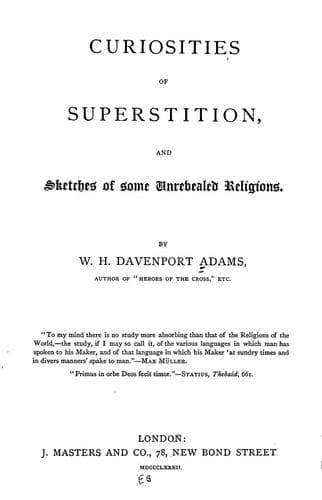
Curiosities of Superstition, and Sketches of Some Unrevealed ReligionsAdams, W. H. Davenport (William Henry Davenport)
Religion
Curiosities of Superstition, and Sketches of Some Unrevealed Religions
Adams, W. H. Davenport (William Henry Davenport)
Folklore; Religions; Superstition
She rushed forward to take a last embrace, but was immediately seized and
bound hand and foot, while her husband’s body was placed in a long basket
made of cocoa-nut leaves, and carried from her sight. The sacrificers were
always exceedingly careful to prevent the wife, or daughter, or any female
relative from touching the corpse; for so polluting were females
considered, that a victim would have been desecrated by a woman’s touch or
breath, to such a degree as to have rendered it unfit for an offering to
the gods.
While the men were bearing their victim to the marae, he recovered from
the stunning effect of the blow, and, bound as he was in the cocoa-nut
leaf basket, said to his murderers: “Friends, I know what you are about to
do with me; you are about to kill me, and offer me as a _tabu_ to your
savage gods; and I also know that it is useless for me to beg for mercy,
for you will not spare my life. You may kill my body, but you cannot hurt
my soul; for I have begun to pray to Jesus, the knowledge of Whom the
missionaries have brought to our island: you may kill my body, but you
cannot hurt my soul.”
This address did not move the compassion of his murderers. Laying their
victim on the ground with a stone under his head, they crushed it to
pieces with another. It appears that he had been selected as a victim
because he had “begun to pray for JESUS;” and it is not unjust, therefore,
to claim for this poor Tahitian savage a place in the noble army of
martyrs.
“The manner in which human victims were sought,” says Williams, “is
strikingly illustrative of many passages of Scripture which portray the
character of heathenism. As soon as the priest announced that such a
sacrifice was required, the king despatched messengers to the chiefs of
the various districts, and upon entering the dwelling they would inquire
whether the chief had a _broken calabash_ at hand, or a _rotten
cocoa-nut_. These and sinister terms were invariably used, and well
understood, when such applications were made. It generally happened that
the chief had some individual on his premises whom he intended to devote
to this horrid purpose. When, therefore, such a request was made, he would
notify, by a motion of the hand or head, the individual to be taken. The
only weapon with which these procurers of sacrifices were armed, was a
small round stone concealed in the hollow of their hand. With this they
would strike their victim a stunning blow upon the back of the head, when
others who were in readiness would rush in and complete the horrid work.
The body was then carried, amid songs and shouts of savage triumph, to the
marae, there to be offered to the gods. At other times, the king’s gang of
desperadoes would arm themselves with spears, surround the house of their
victim, and enjoy the sport of spearing him through the apertures between
the poles which encircled the house. In these circumstances, the object of
Public-domain text, read in full here on John Shaqi.
Reviews
Reviews
No reviews yet
Be the first to share your thoughts on this work.
Elsewhere in the archive
Join the Discussion
Join the discussion
Sign in to leave a comment or review.
Sign InorCreate an account