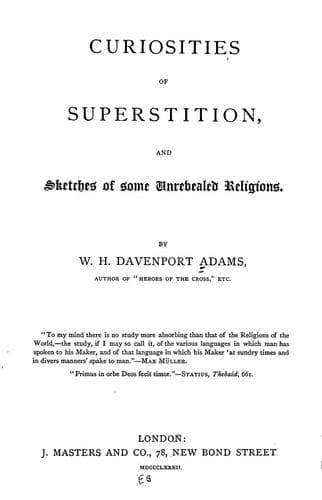
Curiosities of Superstition, and Sketches of Some Unrevealed ReligionsAdams, W. H. Davenport (William Henry Davenport)
Religion
Curiosities of Superstition, and Sketches of Some Unrevealed Religions
Adams, W. H. Davenport (William Henry Davenport)
Folklore; Religions; Superstition
“When a man came to the priests to beg some heavenly, or rather infernal,
favour, they would tell him, either from whim, malice, or some reason best
known to themselves, that the god required a human sacrifice, and naming
the victim, present the supplicant with the death-warrant in the shape of
a sacred stone. He hides this carefully somewhere about him, and
collecting a few friends, seeks out the doomed man. At last they find him
sitting lazily under a tree or mending his canoe, and squatting down round
him begin talking about the weather, fishing, or what not. Suddenly a hand
is opened--the death stone discovered to his horrified view. He starts up
terror-stricken, and tries to escape--one short, furious struggle and he
is knocked down, secured, and carried off to the merciless priests. Ugh!
it is an ugly picture.”[56]
CHAPTER XIII.
_THE FIJI ISLANDERS._
The annexation of the Fiji Islands to the British empire lends to the
practices and beliefs of their inhabitants a peculiar interest, though to
a great extent these have been abandoned since the establishment of
Christianity.
Their creed is undiluted polytheism; their pantheon is full of all kinds
of gods, differing in rank and power, and very widely represented on earth
by some animate or inanimate object. Each Fijian has a god of his own,
under whose care he supposes himself to be placed. They do not seem to
have any religious teaching; but they have a priesthood, and that
priesthood has, of course, its traditional formulas of worship. But
nothing like regular worship, as Christians understand the phrase, is
accepted or observed, and the Fijian religion is really a superstition,
because its sole inspiring motive is fear. This motive the priests
carefully develope, making it the basis of their claims and the source of
their influence.
No man can gain access to the gods except through the priests; and the
priests insist upon liberal offerings. When the worshipper comes upon
questions of importance, the _Soro_ or sacrifice consists of whales’ teeth
and large quantities of food. For matters of inferior moment, the god is
content with a mat, a club, a spear, or a tooth, or even young nuts coated
with turmeric powder. On one occasion, when the chief Tuikilakila
solicited the help of the Somo-somo gods in war, he built a large new
temple to the war-god, and presented a quantity of cooked food, numerous
turtles, and whales’ teeth.
Part of the offering, or _sogaria_, is set apart for the god, and the rest
forms a feast to which everybody is invited. The god’s portion, as the
reader will immediately conclude, is eaten by the priest and old men, but
to the younger members of the community is strictly _tapu_.
Public-domain text, read in full here on John Shaqi.
Reviews
Reviews
No reviews yet
Be the first to share your thoughts on this work.
Elsewhere in the archive
Join the Discussion
Join the discussion
Sign in to leave a comment or review.
Sign InorCreate an account