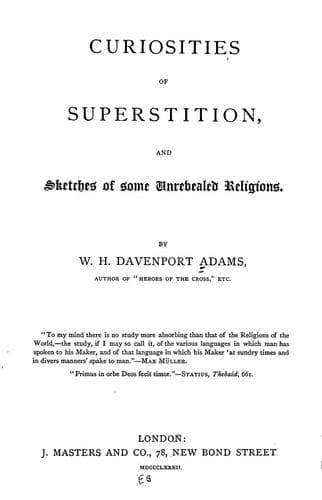
Curiosities of Superstition, and Sketches of Some Unrevealed ReligionsAdams, W. H. Davenport (William Henry Davenport)
Religion
Curiosities of Superstition, and Sketches of Some Unrevealed Religions
Adams, W. H. Davenport (William Henry Davenport)
Folklore; Religions; Superstition
Strangers who desire to consult a god begin by cutting a pile of firewood
for the table. Sometimes only a whale’s tooth and a dish of yams are
presented. It is not necessary that the offering should be made in the
temple. Mr. Williams speaks of priests to whom the inspiration came in a
private house or in the open air.
He who designs to consult the oracle dresses and anoints himself, and,
attended by his friends, goes to the priest, who, we will suppose, has
been previously informed of the intended visit, and is lying near the
sacred corner, preparing his response. When the votary arrives, the priest
rises and sits so that his back is near the white cloth by which the god
visits him, while the others occupy the opposite side. The votary presents
a whale’s tooth, states the object of his visit, and expresses a hope that
the god will regard him with favour. Sometimes in front of the tooth is
placed a dish of scented oil, with which the priest anoints himself, and
then receives the tooth, eyeing it with deep and serious attention.
Unbroken silence follows. The priest, says Mr. Williams, grows absorbed in
thought, and all gaze upon him with unwavering steadfastness. In a few
minutes he trembles; his face appears slightly distorted, and twitching
movements are seen in his limbs. These increase to a violent muscular
action, which spreads until the whole frame is strongly convulsed, and the
man shivers as with an ague fit. In some islands, adds Mr. Williams, this
is accompanied with sobs and murmurs, the veins expand, and the
circulation of the blood is quickened.
The priest is now possessed by his god, and all his words and actions are
henceforth considered as the god’s and not his own. Shrill cries of “Koi
au! Koi au!” (It is I! It is I!) fill the air, and are supposed to
indicate the deity’s approach. While delivering the oracle, the priest’s
eyes stand out and roll, as if a frenzy had seized him; his voice is
unnatural and his face pallid; his lips turn white; his breathing is
laboured; and his whole appearance resembles that of “a furious madman.”
The perspiration streams from every pore; the tears start from his
strained eyes. But by degrees the symptoms disappear, and the priest
stares around with purposeless gaze. Then as the god says “I depart,” he
throws himself down violently on the mat, or suddenly beats the ground
with a club; whereupon those at a distance are informed by blasts on the
conch, or the discharge of a musket, that the deity has returned into the
world of spirits.
It would be a mistake to conclude that in these scenes the priest-actor is
always a conscious impostor; he is frequently the victim of his own
imagination, which he stimulates into an excess of frenzy.
Public-domain text, read in full here on John Shaqi.
Reviews
Reviews
No reviews yet
Be the first to share your thoughts on this work.
Elsewhere in the archive
Join the Discussion
Join the discussion
Sign in to leave a comment or review.
Sign InorCreate an account