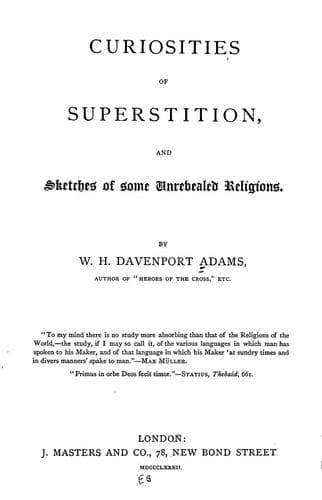
Curiosities of Superstition, and Sketches of Some Unrevealed ReligionsAdams, W. H. Davenport (William Henry Davenport)
Religion
Curiosities of Superstition, and Sketches of Some Unrevealed Religions
Adams, W. H. Davenport (William Henry Davenport)
Folklore; Religions; Superstition
The chronicler of the cruise of the “Challenger” was witness of a native
dance or “maki-maki,” given at Kandavu in honour of the English officers.
When he landed the first “set” had already begun, and torches, consisting
of bundles of palm branches tied together, threw a lurid light over the
savage scene. On a strip of grass in front of the huts were gathered the
dancers, and close around grouped picturesquely on the top of great piles
of cocoa-nuts, or squatting on the ground, were the natives of Kandavu and
the neighbouring villages, officiating as critics, but prepared in their
turn to take part in the wild revelry.
“Glorious Rembrandt effects, as the torches’ flames leapt and fell in the
still night air, bathing with ruddy glow that strange scene around,--the
semi-nude dusky natives chattering, laughing, glistening eyes and white
gleaming teeth, on the reed-built huts, on the foliage above, and flushing
redly up the white trunks of the cocoa-palms. Round a standing group of
tawny-hued boys and girls who formed the band, some two dozen men, dressed
in fantastic manner, their faces blackened, and skins shiny with cocoa-nut
oil, were dancing. Wound round their waists they wore great rolls of
tappa, or white cloth, falling nearly to the knees, and over these, belts
fringed with long narrow streamers of brightly coloured stuff--red,
yellow, and white, surging and rustling with every movement; on their
heads turbans of finely-beaten tappa, transparent and gauzy, piled high in
a peak; gaiters of long black seaweed or grass, strung with white beads;
anklets and armlets of large bone rings, or of beads worked in patterns;
tortoiseshell bracelets and bead necklaces, from which hung in front one
great curled boar’s tusk. Some are dressed better than others, but all in
the same wild style. Moving slowly in a circle round and round the band,
whose clapping and rollicking strain they accompanied by a loud droning
kind of chant, at the end of each stave chiming in with the band with a
simultaneous shout, a sudden swaying of the body, a loud hollow clap of
the hands, once or twice repeated, and a heavy stamp, stamp of the feet;
a moment’s halt and silence, broken plaintively by one of the singers,
quickly taken up by the remainder to a clapping, rattling, and vowely
measure, and again the dancers circle slowly round, swinging their arms
and bodies, clapping, shouting, and droning in faultless time together.”
The first dances were dances of peace; pantomimic representations of the
chief pursuits of a Fijian’s life, as, for instance, fishermen hauling in
their lines, or the tillers of the field planting tare and gathering in
their crops.
Public-domain text, read in full here on John Shaqi.
Reviews
Reviews
No reviews yet
Be the first to share your thoughts on this work.
Elsewhere in the archive
Join the Discussion
Join the discussion
Sign in to leave a comment or review.
Sign InorCreate an account