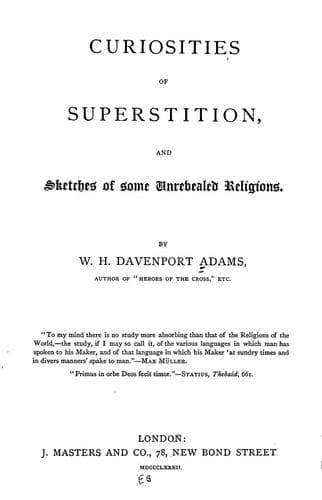
Curiosities of Superstition, and Sketches of Some Unrevealed ReligionsAdams, W. H. Davenport (William Henry Davenport)
Religion
Curiosities of Superstition, and Sketches of Some Unrevealed Religions
Adams, W. H. Davenport (William Henry Davenport)
Folklore; Religions; Superstition
At the sound of a couple of conch-shells the chiefs present did homage, so
to speak, to their new king, who was still deeply affected, and gazing on
the body of one of the murdered women, his father’s eldest and most loving
wife, exclaimed: “Alas, Moalivu! There lies a woman truly unwearied, not
only in the day but the night also; the fire consumed the fuel gathered by
her hands. If we awoke in the still night, the sound of her feet reached
our ears, and if harshly spoken to, she continued to labour only.
Moalivu! alas, Moalivu!”
The bodies of the victims were then wrapped up in mats, placed on a bier,
and carried out of the door; but the old king was borne through a gap
purposely made in the wall of the house. On arriving at the seaside, they
were deposited in a canoe, the old king reclining on the deck, attended by
his wife and the chief priest, who fanned away the insects. The place of
sepulture was at Weilangi. There, in a grave lined with mats, were laid as
“grass” the murdered women. Upon them was stretched the dying king, who
was stripped of his regal ornaments, and completely enveloped in mats.
Lastly, the earth was heaped over him, though he was still alive. At the
end of the ceremony the new king returned to his “palace,” not unmindful
of the fact that in the course of time a similar fate awaited himself.
* * * * *
Since the annexation of the Fiji Islands, such a scene as this has, of
course, become impossible. Cannibalism, to which the Fijians were largely
addicted, has also, been prohibited. Lord George Campbell, in his “Log of
the Challenger,” written in 1876, says that those who lived in the
interior still cherished cannibalistic tendencies, and he seems to have
been of opinion that cannibalism prevailed in those parts to which
missionaries or civilisation had not yet penetrated. But under the firm
rule of Sir Arthur Gordon it was doubtless extirpated.
Even in Lord George Campbell’s time the change effected by the sacred
influence of Christianity had been “great indeed.” A party of English
officers made a boat-excursion to the large island of Bau, where the king
lived. They found him dressed in a waist-cloth, lying on his face in a
hut, reading the Bible. Not far distant were the great stones against
which they used to kill the sacrificial victims, battering their heads
against them till dead. There too they saw a great religious “maki-maki,”
hundreds of men and women dancing, and singing New Testament verses before
Wesleyan missionaries, who, sitting at a table, received the
money-offerings of their converts as they defiled before them dancing and
singing.
We have sketched a hideous scene belonging to the past, and associated
with the darkest superstitions of the Fijians. We shall adapt from Lord
George Campbell a more pleasing picture, in which the past mingles with
the present, and the old and the new are not unhappily blended.
Public-domain text, read in full here on John Shaqi.
Reviews
Reviews
No reviews yet
Be the first to share your thoughts on this work.
Elsewhere in the archive
Join the Discussion
Join the discussion
Sign in to leave a comment or review.
Sign InorCreate an account