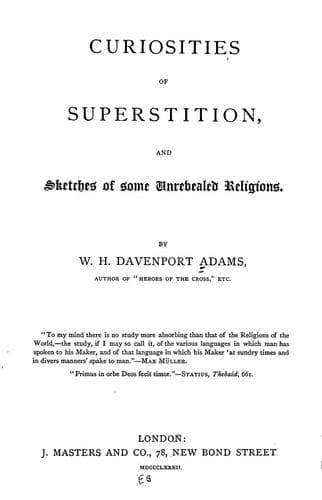
Curiosities of Superstition, and Sketches of Some Unrevealed ReligionsAdams, W. H. Davenport (William Henry Davenport)
Religion
Curiosities of Superstition, and Sketches of Some Unrevealed Religions
Adams, W. H. Davenport (William Henry Davenport)
Folklore; Religions; Superstition
Travelling on the borders of Chinese Tartary, in the country of the Lamas
or Buddhists, Miss Gordon Cumming remarks that it was strange, every now
and again, to meet some respectable-looking workman, twirling little brass
cylinders, only about six inches in length, which were incessantly
spinning round and round as they walked along the road. What could they
be? Not pedometers, not any of the trigonometrical instruments with which
the officers of the Ordnance Survey go about armed? No; she was informed
that they were prayer-wheels, and that turning them was just about
equivalent to the telling of beads, which in Continental lands workmen may
often be seen counting as homeward along the road they plod their weary
way.
The telling of beads seems to the Protestant a superfluous piece of
formalism: what then are we to think of prayer by machinery? The prayers,
or rather invocations, to Buddha--the Buddhists never pray, in the
Christian sense--are all closely written upon strips of cloth or paper;
the same sentence being repeated some thousands of times. These strips are
placed inside a cylinder, revolving on a long spindle, the end of which is
the handle. From the wind-cylinder depends a small lump of metal, which,
whirling round, communicates the necessary impetus to the little machine,
so that it rotates with the slightest possible effort, and continues to
grind any required number of acts of worship, while the owner, with the
plaything in his hand, carries on his daily work. His religion requires
that he should be all his time immersed in holy contemplation of the
perfections of Buddha, but to a busy man no such self-absorption is
possible. He is content, therefore, to say the sentences aloud at the
beginning and end of his devotions, and in the interval twirls slowly,
while a tiny bell marks each rotation, and reminds him if he should
unconsciously quicken his pace.
Tennyson finely speaks of Prayer as that by which
“The whole round world is every way
Bound by gold chains around the feet of GOD;”
but no such efficacy can be ascribed to the cylinders of brass, copper, or
gold, which are fashionable among the Buddhists. Yet we must not condemn
too unreservedly: Prayer, even among Christians, is apt to degenerate into
a dull, mechanical uniformity, and to become scarcely less perfunctory
than that which the Tibetans grind out of their prayer-machine.
Public-domain text, read in full here on John Shaqi.
Reviews
Reviews
No reviews yet
Be the first to share your thoughts on this work.
Join the Discussion
Join the discussion
Sign in to leave a comment or review.
Sign InorCreate an account