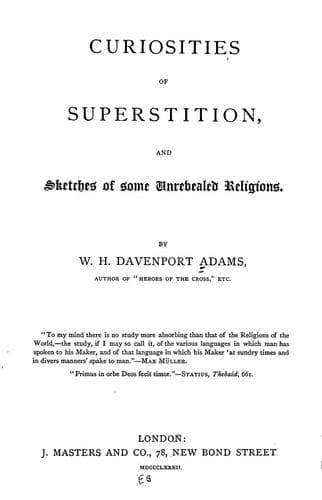
Curiosities of Superstition, and Sketches of Some Unrevealed ReligionsAdams, W. H. Davenport (William Henry Davenport)
Religion
Curiosities of Superstition, and Sketches of Some Unrevealed Religions
Adams, W. H. Davenport (William Henry Davenport)
Folklore; Religions; Superstition
The Good Spirit of the Maories is called Atua; the Evil Spirit, Wairua.
All evil spirits, or all the objects representing them, are known as
Wairuas, and all the emblems or types of the Good Spirit as Atuas; but
there is one supreme Goodness, one great and overruling God, to which the
name of Atua is also applied.
According to Mr. Angas, the _Kakariki_, or green lizard, is specially
venerated as an Atua. On one occasion, during the early days of Christian
mission work in New Zealand, a missionary was examining a phial of green
lizards, and a Maori entering the room, the missionary showed it to him.
Whereupon the Maori immediately exhibited all the signs of extreme terror,
and exclaiming, “I shall die! I shall die!” proceeded to crawl away on his
hands and knees. Any novel object, any object beyond the intelligence of
the Maories, they convert into an Atua. Thus, a barometer is an Atua,
because it indicates changes of weather; a compass, because it points to
the north; a watch, because it mysteriously records the progress of time.
Not to these typical atuas, however, does the Maori render the homage of
prayer and praise; this he reserves for the supreme and unseen Atua, and
offers through the agency of his priests or tohungas. It is to be feared
that these prayers are often unintelligible to those on whose behalf they
are offered, but the Maories do not the less heartily believe in them;
and, indeed, the history of religion all over the world presents
innumerable illustrations of the fact that faith is not incompatible with
ignorance. It is the very essence and secret of Superstition. Whether they
understand the prayers of the tohungas or not, they delight in their
frequent repetition, and insist upon their use in almost every
circumstance of life. They are generally accompanied by offerings of
animal and vegetable food, which, of course, become the perquisites of the
tohungas.
Public-domain text, read in full here on John Shaqi.
Reviews
Reviews
No reviews yet
Be the first to share your thoughts on this work.
Elsewhere in the archive
Join the Discussion
Join the discussion
Sign in to leave a comment or review.
Sign InorCreate an account