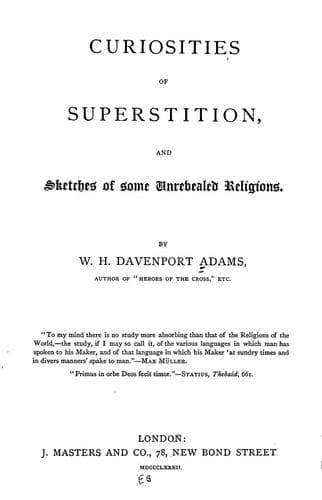
Curiosities of Superstition, and Sketches of Some Unrevealed ReligionsAdams, W. H. Davenport (William Henry Davenport)
Religion
Curiosities of Superstition, and Sketches of Some Unrevealed Religions
Adams, W. H. Davenport (William Henry Davenport)
Folklore; Religions; Superstition
The Maori priesthood is hereditary, father transmits his office to son,
after carefully educating him in its duties. Dr. Dieffenbach was present
when an aged tohunga was giving a lesson to a neophyte. The old priest, he
says, was sitting under a tree, with part of a man’s skull, filled with
water, by his side. At intervals he dipped a green branch into the water,
and sprinkled the hand of a boy, who reclined at his feet, and listened
attentively to his recital of a long string of words. Dr. Dieffenbach
doubts the common statement that the prayers are often without meaning,
while agreeing that they are unintelligible to the majority of the
worshippers. He thinks they are couched in a language now forgotten; or,
what is more probable, that among the Maories as among many of the nations
of antiquity, the religious mysteries are carefully confined to a certain
class of men, who conceal them from the _profanum vulgus_, or reveal only
such portions as they think proper. The claims of the exponents of an
artificial creed must necessarily depend in a great degree upon the amount
of mystery in which they involve it. With the common people familiarity
breeds contempt; they venerate that only which they do not understand; it
is darkness and not light which moves their wonder, and excites their awe.
Devoid as it is of elevated attributes, the religion of the Maori rises
above some of the Polynesian creeds in its acknowledgment of the
immortality of man, though on this point its teaching is very vague.
The Maori believes that, after death, his soul enters the Reinga, or abode
of departed spirits; and, with an unwonted touch of poetry, he looks upon
shooting and falling stars as souls passing swiftly to this undiscovered
bourne; the entrance to which he supposes to lie beneath a precipice at
Cape Maria Van Diemen. The spirits in falling are supposed to rest
momentarily, in order to break the descent, against an ancient tree, which
grows about half way down. The natives were wont to indicate a particular
branch as being the halting-place of the spirits; but a missionary having
cut it off, the tree has of late diminished in sanctity.
The entrance to the Reinga is not accomplished by all spirits in the same
manner. Those of the chiefs ascend in the first place to the upper
heavens, where each chief leaves his left eye, this left eye becoming a
new star. Hence the custom in Maori warfare for the victor to eat the left
eye of a chief slain in battle, in the conviction that by this process he
absorbed into his own system the skill, sagacity, and courage of the
departed.
It is humiliating, perhaps, to record these illustrations of human folly;
but they are valuable as proofs of the depths to which Humanity descends
when unaided by the elevating influence of revealed religion.
Public-domain text, read in full here on John Shaqi.
Reviews
Reviews
No reviews yet
Be the first to share your thoughts on this work.
Elsewhere in the archive
Join the Discussion
Join the discussion
Sign in to leave a comment or review.
Sign InorCreate an account