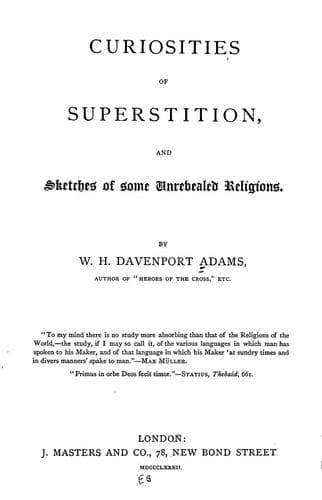
Curiosities of Superstition, and Sketches of Some Unrevealed ReligionsAdams, W. H. Davenport (William Henry Davenport)
Religion
Curiosities of Superstition, and Sketches of Some Unrevealed Religions
Adams, W. H. Davenport (William Henry Davenport)
Folklore; Religions; Superstition
Let us take, for example, the Khonds of Orissa, who keep up a system of
human sacrifice, absolutely elaborate in its details. Its primary
condition is that the victim, or Meriah, should be _bought_. Even if taken
in war, he must be sold and purchased before the priest will accept him.
No distinction is made as to age or sex; but the efficiency of the victim
seems to depend on the sum he costs, and therefore the healthy are
preferred to the feeble, and adults to children. The number consumed in a
twelvemonth must be very considerable; as the Khonds do not believe in the
success of any undertaking, or in the promise of their fields, unless a
Meriah is first offered.
The victims are kindly treated during the period of their captivity, which
is sometimes of considerable duration. In truth, a Meriah or dedicated
maiden is sometimes allowed to marry a Khond, and to live until she has
become twice or thrice a mother. Her children as well as herself are
destined to the sacrificial altar; but must never be slain in the village
in which they are born. To overcome this difficulty, one village exchanges
its Meriah children with another.
There are various modes of accomplishing the sacrifice. In Goomten the
offering is made to the Earth-god, Tado Pumor, who is represented by the
emblem of a peacock. For a month previous to the day of doom, the people
maintain an almost continuous revel, feasting and dancing round the
Meriah, who seems to enter into the festivity with as much zest as they
do. On the last day but one he is bound to a stout pole, the top of which
carries the peacock emblem of the Tado Pumor; and around him wheel and
wheel the revellers, protesting in their wild rude songs that they do not
murder a victim, but sacrifice one who has been fairly purchased, and
that, therefore, his blood will not be upon their heads. The Meriah, being
stupefied with drink, makes no answer; and his silence is interpreted as a
willing assent to his immolation. Next day he is anointed with oil, and
carried round the village; after which he is brought back to the post, at
the bottom of which a small pit has been dug. A hog is killed, and the
blood poured into the pit, and mixed with the soil until a thick mud is
formed. Into this mud the face of the Meriah is pressed until he dies from
suffocation. It should be added that he is always unconscious from
intoxication when brought to the post.
The zani, or officiating priest, cuts off a fragment of the victim’s
flesh, and buries it near the pit; as an offering to the earth; after
which the spectators precipitate themselves upon the body, hack it to
pieces, and carry away the fragments to bury in their fields as a
propitiation to the rural deities.
Public-domain text, read in full here on John Shaqi.
Reviews
Reviews
No reviews yet
Be the first to share your thoughts on this work.
Elsewhere in the archive
Join the Discussion
Join the discussion
Sign in to leave a comment or review.
Sign InorCreate an account