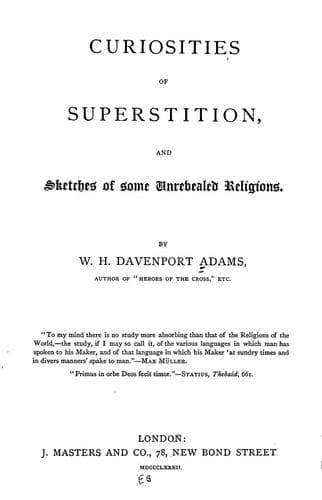
Curiosities of Superstition, and Sketches of Some Unrevealed ReligionsAdams, W. H. Davenport (William Henry Davenport)
Religion
Curiosities of Superstition, and Sketches of Some Unrevealed Religions
Adams, W. H. Davenport (William Henry Davenport)
Folklore; Religions; Superstition
“The entire pah is now (1863) in ruins, and has been made tapu by Te
Heuhen since its destruction. Here, then, all was forbidden ground; but I
eluded the suspicions of our natives, and rambled about all day amongst
the decaying memorials of the past, making drawings of the most striking
and peculiar objects within the pah. The cook-houses, where the father of
Te Heuhen had his original establishment, remained in a perfect state; the
only entrances to these buildings were a series of circular apertures, in
and out of which the slaves engaged in preparing the food were obliged to
crawl.
“Near to the cook-houses stood a carved patuka, which was the receptacle
of the sacred food of the chief; and nothing could exceed the richness of
the elaborate carving that adorned this storehouse.... Ruined
houses--many of them once beautifully ornamented and richly
carved--numerous _waki-tapu_, and other heathen remains with images and
carved posts, occur in various portions of this extensive pah; but in
other places the hand of Time has so effectually destroyed the buildings
as to leave them but an unintelligible mass of ruins. The situation of
this pah is admirably adapted for the security of the inmates: it commands
the lake on the one side, and the other fronts the extensive marshes of
Tukanu, where a strong palisade and a deep moat afford protection against
any sudden attack. Water is conveyed into the pah through a sluice or
canal for the supply of the besieged in times of war.
“There was an air of solitude and gloomy desolation about the whole pah,
that was heightened by the screams of the plover and the tern, as they
uttered their mournful cry through the deserted coasts. I rambled over the
scenes of many savage deeds.”
* * * * *
Cannibalism, or to use the scientific term, anthropophagy, has its origin
in different causes, and assumes different forms. Among some of the savage
peoples it is, as among the Maories, simply the expression of a sanguinary
instinct, of an atrocious sentiment of revenge. Among others it originates
in a chronic condition of misery and famine. Yet, again, it is sometimes
connected with the custom of human sacrifices, as among the Aztecs, and
those who practise it come to esteem it a sacred duty, pleasing to their
deities, or even to the _manes_ of their hapless victims.
Unknown among the simple Eskimos, and, indeed, among all the hyperborean
races, anthropophagy prevails with more or less intensity among peoples
which have attained a rudimentary civilization.
Public-domain text, read in full here on John Shaqi.
Reviews
Reviews
No reviews yet
Be the first to share your thoughts on this work.
Elsewhere in the archive
Join the Discussion
Join the discussion
Sign in to leave a comment or review.
Sign InorCreate an account