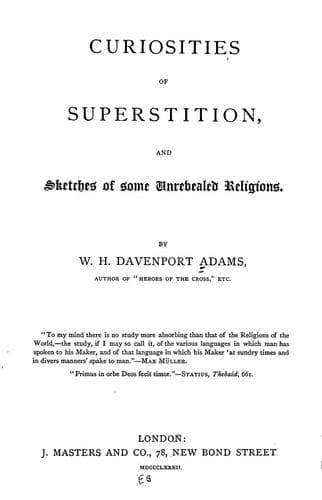
Curiosities of Superstition, and Sketches of Some Unrevealed ReligionsAdams, W. H. Davenport (William Henry Davenport)
Religion
Curiosities of Superstition, and Sketches of Some Unrevealed Religions
Adams, W. H. Davenport (William Henry Davenport)
Folklore; Religions; Superstition
In this condition he revolves faster and faster, without the least hope of
escape or relief, until he again falls into a swoon; his voice falters,
his strugglings cease; he hangs a still and apparently lifeless thing.
“When he is by turning gradually brought to this condition, which is
generally done within ten or fifteen minutes, there is a close scrutiny
passed upon him among his tormentors, who are checking and holding each
other back as long as the least struggling or tremor can be discovered;
lest he should be removed, before he is, as they term it, dead.”
Having satisfied themselves that their victim is not feigning, they give a
signal; he is lowered to the ground; the skewers which passed through his
breast are removed, and the ropes attached to another candidate. He is
allowed to lie where he fell; none dare to touch him; to do so would be a
sacrilege, because he has placed himself under the protection of the Great
Spirit.
After awhile he partially recovers, and crawls to another part of the
lodge, where, with gleaming axe in hand and a bison’s skull before him,
sits a medicine-man. Holding up the little finger of his left hand as a
sacrifice to the Great Spirit, the neophyte lays it upon the skull, and,
in a moment, the medicine-man’s axe severs it. Sometimes the fore-finger
of the same hand is also offered, and only the thumb and two middle
fingers, which are necessary in holding the bow, are left.
Then comes the last scene of this strange, eventful history, bringing the
neophyte’s sufferings to a climax. The skewers by which he is suspended to
the roof are removed when he is lowered, but eight still remain; two in
each arm, and two in each leg. To each is attached a heavy weight, such as
a bison’s skull, and they must not be _drawn_ out, but must be _torn_ out
by sheer force. With this view he is required to run the last race,--which
takes place in the open air, and in the presence of a concourse of excited
spectators. Leaving the medicine-lodge, the master of the ceremonies leans
his head against the Big Canoe, and fills the air with a loud long wail.
Immediately a score or so of young men, all matched in height, wearing
beautiful dresses of eagle-quills, and carrying in one hand a wreath of
willow-boughs, issue from the dressing-hut. On arriving at the Big Canoe
they assemble round it in a circle, holding on to each other’s
willow-wreath, and then race around it at their utmost speed, screaming
and shouting until the air is filled with their uproar.
The candidates then come out of the medicine-lodge, dragging the heavy
weights attached to their limbs, and are stationed at equal intervals
outside the ring of runners. As each takes his place, two powerful young
men take charge of him, who pass round each of his wrists a broad
leathern strap, which they grasp very firmly, but without tying it.
Public-domain text, read in full here on John Shaqi.
Reviews
Reviews
No reviews yet
Be the first to share your thoughts on this work.
Elsewhere in the archive
Join the Discussion
Join the discussion
Sign in to leave a comment or review.
Sign InorCreate an account