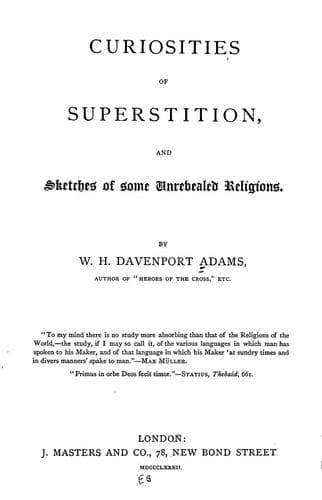
Curiosities of Superstition, and Sketches of Some Unrevealed ReligionsAdams, W. H. Davenport (William Henry Davenport)
Religion
Curiosities of Superstition, and Sketches of Some Unrevealed Religions
Adams, W. H. Davenport (William Henry Davenport)
Folklore; Religions; Superstition
When all the preliminaries are completed, a signal is given, and the
neophytes begin to race round the Big Canoe, outside the inner circle,
each man being dragged along by his custodians, until the skulls and other
weights drag out the skewers to which they are fastened. The bystanders
scream and yell and shout in a frenzy of excitement; eager, moreover, to
drown the groans of the sufferers, should the instincts of nature prevail
over their self-control, and desirous of encouraging them in their final
trial.
Sometimes the neophyte’s flesh proves to be so tough that the skewers
cannot be dragged out, and in such cases their friends jump on the skulls
as they rattle along the ground, so as to increase their weight.
Humanity cannot long endure a torture so horrible: the sufferers quickly
faint, though they are still hauled round in the barbarous race, nor set
free until the last weight is dragged from the quivering, bleeding body.
Then the unconscious wretch is released, and left, for the second time, in
the care and protection of the Great Spirit. In due time he recovers his
senses, struggles to his feet, totters through the crowd, is received by
his friends, and conducted to his own hut.
Mr. Catlin supplies two illustrations of the rigorous tenacity with which
the Indians adhere to the rule that the skewers must be _dragged_, not
_removed_, from the sufferer’s flesh.
In one case the skewer had chanced to pass under a sinew, and the neophyte
was dragged round and round the ring in vain. In vain his friends added
their weight to that of the bison’s skulls. The scene became so horrible
that even the spectators could no longer endure it, and in sympathy with
their cries the master of the ceremonies stopped the race, leaving the
youth, unconscious, on the ground. As soon as he regained his senses, he
crawled away to the prairie on his hands and knees, and there remained,
without food or drink, for three hours longer, until suppuration took
place, and he was enabled to get rid of the skewer. Then he crawled home,
and strange to say, notwithstanding the agony he had undergone, and his
loss of strength, recovered in a few days.
In the second case, two of the weights attached to the arms refused to
yield, and the hapless neophyte crept as best he could to the steep bluff
overhanging the river, where he drove a stake into the ground. Fastening
the weights to this stake by a couple of ropes, he lowered himself about
midway down the cliff, and so hung suspended for more than two days, until
the obstinate flesh gave way, and allowed him to drop into the water. He
swam to the side, crawled up the acclivity, and returned to his village.
It gives one a vivid idea of the remarkable vitality and physical force of
the Indian race, when one reads that this man, too, recovered!
* * * * *
Public-domain text, read in full here on John Shaqi.
Reviews
Reviews
No reviews yet
Be the first to share your thoughts on this work.
Elsewhere in the archive
Join the Discussion
Join the discussion
Sign in to leave a comment or review.
Sign InorCreate an account