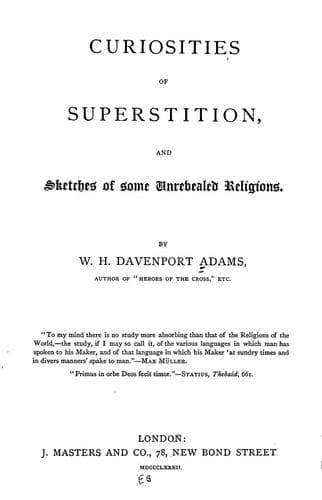
Curiosities of Superstition, and Sketches of Some Unrevealed ReligionsAdams, W. H. Davenport (William Henry Davenport)
Religion
Curiosities of Superstition, and Sketches of Some Unrevealed Religions
Adams, W. H. Davenport (William Henry Davenport)
Folklore; Religions; Superstition
It chanced that, as he ended his oration, a steamer, the first that had
ever ploughed the Missouri river, fired a salute from a twelve-pounder
gun, as she passed the Mandan village. To the Indians the roar of the
cannon was like the voice of thunder, and their joy knew no bounds. The
successful medicine-man was loaded with valuable gifts; mothers hastened
to offer their daughters to him in marriage; and the elder medicine-men
issued from the lodge, eager to enrol him in their order. But, from the
roof of the lodge, where he had taken his stand, Wak-a-dah-ha-ku
discovered the steamer, as she dashed up the river, and discharged her gun
again and yet again. He hastened to address the chiefs and people,
explaining that the sounds they heard were not those of thunder, but that
his potent medicine had brought a thunder-boat to the village. To the
river-bank rushed the wondering population, and the rest of the day was
spent in a fever of excitement, in which the rain-maker was forgotten.
Just before sunset his quick eyes discovered a black cloud, which,
unobserved by the noisy multitude, swiftly came up from the horizon. At
once he assumed his station on the roof of the lodge; strung his bow and
made ready his arrow; arrested the attention of his fellows by his loud
and exultant speech; and as the cloud impended over the village, shot his
arrow into the sky. Lo, the rain immediately descended in torrents,
wetting the rain-maker to the skin, but establishing in everybody’s mind a
firm and deep conviction of his power.
All night raged the storm; but unhappily a flash of lightning penetrated
one of the wigwams, and killed a young girl. The newly-made medicine-man
was sorely terrified by this catastrophe, which he feared the chiefs would
impute to him, making him responsible for the girl’s death, and punishing
him accordingly.
But he was a man of much astuteness, and early in the morning, collecting
three of his best horses, he mounted the lodge-roof again, and for a third
time addressed the people of his tribe.
“Friends,” he said, “my medicine was too strong, I am young, and I did not
know where to stop. I did not regulate its power. And now the wigwam of
Mah-sish is laid low, and many are the eyes that weep for Ko-ka, the
antelope. Wak-a-dah-ha-ku gives three horses to rejoice the hearts of
those who sorrow for Ko-ka. His medicine is great. His arrow pierced the
black cloud, and the lightning came, and with it the thunder-boat. Who
says that the medicine of Wak-a-dah-ha-ku is not strong?”
This artful address was received with much favour, and thenceforward
Wak-a-dah-ha-ku was known as the “Big Double Medicine.”
Of the medical practices of these medicine-men Mr. Kane, in his
“Wanderings of an Artist,” furnishes a striking illustration.
Public-domain text, read in full here on John Shaqi.
Reviews
Reviews
No reviews yet
Be the first to share your thoughts on this work.
Elsewhere in the archive
Join the Discussion
Join the discussion
Sign in to leave a comment or review.
Sign InorCreate an account