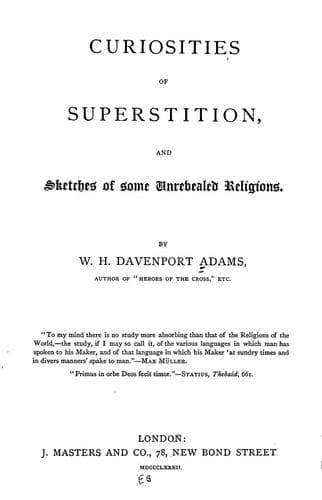
Curiosities of Superstition, and Sketches of Some Unrevealed ReligionsAdams, W. H. Davenport (William Henry Davenport)
Religion
Curiosities of Superstition, and Sketches of Some Unrevealed Religions
Adams, W. H. Davenport (William Henry Davenport)
Folklore; Religions; Superstition
It is seldom that an Indian will voluntarily part with his medicine-bag,
and if he does, he forfeits his reputation almost irretrievably. Now and
then he is persuaded by the white man to bury it, but its place of
interment immediately assumes an air of sanctity in his eyes. He frequents
the spot as if drawn thither by an irresistible influence, will throw
himself on the sod, and talk to the buried treasure as if it were alive.
Sometimes he will offer sacrifices to it, and if he be a rich man, will
even offer a horse. On the latter occasion, the whole tribe take part in
the ceremony, and march forth to the prairie in picturesque procession,
led by the owner of the medicine-bag, who drives before him his most
valued and valuable steed, decked with coloured devices. At the appointed
spot, he delivers a long prayer or oration to the Great Spirit, and sets
free the horse, which thenceforth enjoys the free life of the wild horses
of the prairie, and if at any time recaptured is immediately released.
The position which in most savage tribes is held by the priest, among the
American Indians is held by the “medicine-man.” His influence is
considerable, and his powers are supposed to be vast. He is called upon to
heal the sick and save the dying, and, above all, to bring down the genial
rain from heaven when it is needed for the growth of the crops.
We owe to Mr. Catlin an interesting description of the rain-making
ceremony. A drought had withered the maize-fields for some weeks, and
application for help having been made to the medicine-men they duly set to
work. On the first day one Wah-ku, or the Shield, came to the front; but
failed--that day an equally unsuccessful experiment was made by Om-pah, or
the Elk. The third day was devoted to Wa-rah-pa, or the Beaver, and on the
fourth recourse was had to Wak-a-dah-ha-ku, the White Buffalo Hair, who
was strong in the possession of a shield coloured with red lightnings, and
in the arrow which he carried in his hand.
Taking his station by the medicine-lodge, he harangued the people,
protesting that for the good of his tribe he was willing to sacrifice
himself, and that if he did not bring the much-desired rain, he was
content to live for the rest of his life with the old women and the dogs.
He asserted that the first medicine-man had failed, because his shield
warded off the rain-clouds; the second, who wore a head-dress made of a
raven’s skin, because the raven was a bird that soared above the storm,
and cared not whether the rain came or stayed; and the third, because the
beaver was always wet, and required no rain. But as for him,
Wak-a-dah-ha-ku, the red lightnings on his shield would attract the
rain-clouds, and his arrow would pierce them, and pour the water over the
thirsty fields.
Public-domain text, read in full here on John Shaqi.
Reviews
Reviews
No reviews yet
Be the first to share your thoughts on this work.
Elsewhere in the archive
Join the Discussion
Join the discussion
Sign in to leave a comment or review.
Sign InorCreate an account