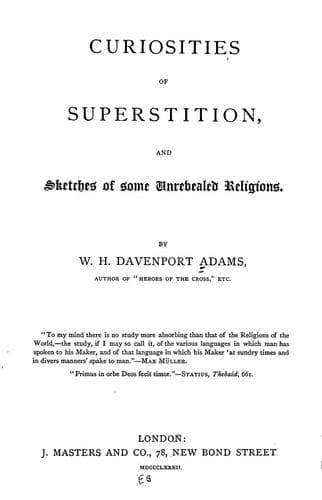
Curiosities of Superstition, and Sketches of Some Unrevealed ReligionsAdams, W. H. Davenport (William Henry Davenport)
Religion
Curiosities of Superstition, and Sketches of Some Unrevealed Religions
Adams, W. H. Davenport (William Henry Davenport)
Folklore; Religions; Superstition
But error is slow to die; and long after the introduction of Christianity
men continued to think that GOD would not hear them, unless, like the
priests of Baal, they approached Him in blood and tears. At the bottom of
it lay, no doubt, a truth, that the spirit could be exalted and purified
only by contempt of the flesh:--and not perceiving that what was demanded
of them was a moral and spiritual victory, they sought, by sore treatment
of the body, to conquer its sinful appetites. They forgot that CHRIST had
spoken of the body as “a temple,”--the temple of the HOLY GHOST; that it
was as much the creation of GOD as the immortal soul, and as His wondrous
handiwork should be treated with the reverence due to all that He has
made. And they came to look upon the body as a deadly enemy, the slave and
accomplice of the devil, which could be subdued only by a regimen of pain
and terror. And so, when an evil suggestion tempted them, they scourged
themselves until the blood ran from their mangled flesh, or they plunged
naked into the deep winter snow, or barefooted they trod the flinty soil,
or they fasted until the exhausted brain sank into the stupor of delirium.
Thus we read of S. Hilarion:--
Covering his limbs only with a sackcloth, and having a cloak of skin, he
wandered forth into the desert that lies beyond Gaza, and enjoyed the
“vast and terrible solitude,” feeding on only fifteen figs after the
setting of the sun; and because the region was of ill repute from
robberies, no man had ever before stayed in that place. The devil, seeing
what he was doing, and whither he had gone, was tormented. And he who of
old boasted, saying: “I shall ascend into heaven, I shall sit above the
stars of heaven, and shall be like unto the Most High,” now saw that he
had been conquered by a boy, and trampled under foot by him, who, on
account of his youth, could commit no sin. He therefore began to tempt his
senses; but he, enraged with himself, and beating his breast with his
fist, as if he would drive out thoughts by blows, “I will force thee, mine
ass,” said he, “not to kick; and feed thee with straw, not barley. I will
wear thee out with hunger and thirst; I will burden thee with heavy loads;
I will hunt thee through heat and cold, till thou thinkest more of food
than of play.” He therefore sustained his sinking spirit with the juice of
herbs and a few figs, after each three or four days, praying frequently,
and singing psalms, and digging the ground with a mattock, to increase the
labour of fasting by that of work. At the same time, by weaving baskets of
rushes, he imitated the discipline of the Egyptian monks, and the
Apostle’s saying, “He that will not work, neither let him eat,” till he
was so attenuated, and his body so exhausted, that his flesh scarce clung
to his bones.
Public-domain text, read in full here on John Shaqi.
Reviews
Reviews
No reviews yet
Be the first to share your thoughts on this work.
Elsewhere in the archive
Join the Discussion
Join the discussion
Sign in to leave a comment or review.
Sign InorCreate an account