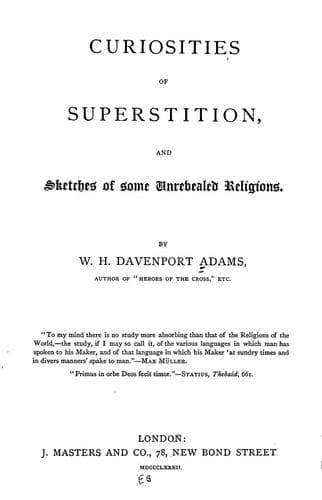
Curiosities of Superstition, and Sketches of Some Unrevealed ReligionsAdams, W. H. Davenport (William Henry Davenport)
Religion
Curiosities of Superstition, and Sketches of Some Unrevealed Religions
Adams, W. H. Davenport (William Henry Davenport)
Folklore; Religions; Superstition
“From his sixteenth to his twentieth year,” says Kingsley, “he was
sheltered from the heat and rain in a tiny cabin, which he had woven of
rush and sedge. Afterwards he built a little cell, four feet wide and five
feet high,--that is lower than his own stature, and somewhat longer than
his small body needed,--so that you would believe it a tomb rather than a
dwelling. He cut his hair only once a year, on Easter Day, and lay till
his death on the bare ground and a layer of rushes, never washing the sack
in which he was clothed, and saying that it was superfluous to seek for
cleanliness in hair-cloth. Nor did he change his linen until the first was
utterly in rags. He knew the Scriptures by heart, and recited them after
his prayers and psalms as if GOD were present.”
Of S. Simeon Stylites we read that, having gone to the well one day to
draw water, he took the rope from the bucket, and wound it round his body
from his loins to his neck, and going in, he adventured an audacious
falsehood, for he said to his brethren, “I went out to draw water, and
found no rope on the bucket.” And they said, “Hold thy peace, brother,
lest the Abbot know it, till the thing has passed over.” But the tightness
and roughness of the rope wore grievous wounds in his body, as the
brethren at last discovered. Then with great trouble they took off the
rope, and his flesh with it, and attending to his wounds, healed them.
For twenty-eight years of his life he was continually experimenting in
long fasts--forty days at a time. Custom gradually made it comparatively
easy to him. For on the first days he used to stand and praise GOD; after
that, when through emptiness he could stand no longer, he would sit and
perform the divine office, and on the last day even lie down. For when his
strength failed slowly, he was forced to lie half dead. But after he stood
on the column he could not bear to lie down, but invented another way by
which he could stand. He fastened a beam to the column, and tied himself
to it by ropes, and so passed the forty days. But afterwards, when endued
with greater grace from on high, he did not need even that assistance, but
stood for the whole forty days, dispensing with food, but strengthened by
eagerness of soul and the divine help.
At length he caused a pillar to be built, first of six cubits, then of
twelve, next of twenty-two, and finally of thirty-six, and upon the top of
this he took his station. The sun beat upon his bare head in the summer,
and the winter snows fell upon him, and the pitiless rains soaked him to
the skin,--but still he endured his self-imposed penance. He bowed himself
frequently, offering adoration to GOD; so frequently that a spectator
counted 1244 adorations, and then missing gave up counting; and each time
he bowed himself, he touched his feet with his forehead. And ever in
spirit he deprecated the wrath of an offended GOD, to Whom, as a meet
sacrifice, he offered up his poor, wounded, tortured, emaciated body.
Public-domain text, read in full here on John Shaqi.
Reviews
Reviews
No reviews yet
Be the first to share your thoughts on this work.
Elsewhere in the archive
Join the Discussion
Join the discussion
Sign in to leave a comment or review.
Sign InorCreate an account