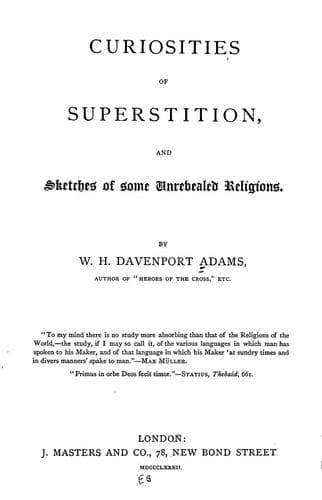
Curiosities of Superstition, and Sketches of Some Unrevealed ReligionsAdams, W. H. Davenport (William Henry Davenport)
Religion
Curiosities of Superstition, and Sketches of Some Unrevealed Religions
Adams, W. H. Davenport (William Henry Davenport)
Folklore; Religions; Superstition
The curious superstition that ghosts are visible to dogs, to which we find
an allusion in Homer’s Odyssey, still flourishes in India. It may have
originated in the place given to the dog in the mythology of both Greek
and Hindu, or in the position enjoyed by the watch-dog among all the
shepherd peoples of the world. The belief belongs to the Semitic as well
as the Aryan races; and its true origin after all may be the apparently
causeless howling of the dog at night,--the time when “spirits walk
abroad.” Whatever the ground of the belief, it is probably in itself the
cause of the superstition that the howling of dogs presages death or
misfortune.
Another singular coincidence of this kind is furnished “by the custom of
spitting on the breast as a charm against fascination.” In his “Greek
Antiquities,” Potter notes that it was an ancient Greek custom to spit
three times on the breast at the sight of a madman; and Theocritus has,--
τοιάδε μυθίζοισα τρὶς εἰς ἑὸν ἔπτυσε κόλπον.
“Precisely the same effect is attributed to the act among the Aryan
inhabitants of India, where its threefold repetition is also insisted on.
No sort of reason that we can imagine, can be found for this belief; and
in this case the idea is a complex one.
“The notion of a hiccough being an indication that some one is thinking of
the person affected, is equally common in Europe and in India.
“The same may be said of the superstition regarding an itching of the palm
of the hand; and further the idea that the palm should be rubbed against
something to make the event the more sure, prevails both in India and in
England. In England it should be ‘rubbed against wood,’ in India on the
forehead.”[67]
We supply but one more illustration, and that shall be in folk lore; a
nursery story which presents virtually the same features in the East as in
the West. The following is the Hindu parallel to the old Saxon nursery
tale of “The Woman that found a Silver Penny.” The coincidence will be
seen to be complete.
“Once upon a time, a little bird, on its way through the woods, picked up
a pea, and took it to the _barbhunja_ to be split; but, as ill luck would
have it, one half of it stuck fast in the mill-handle, and the _barbhunja_
being unable to get it out, the little bird went off to the carpenter, and
said, ‘Carpenter, carpenter, come and cut the mill-handle; my pea is in
the mill-handle; what shall I eat, what shall I drink, and what shall I
take to foreign countries?’ ‘Be off,’ said the carpenter, ‘is it likely I
shall come and cut the mill-handle for the sake of a single pea?’
“Then the little bird went to the king, and said, ‘King, king, chide the
carpenter; the carpenter won’t cut the mill-handle; my pea has stuck in
the mill-handle; what shall I eat, what shall I drink, and what shall I
take to foreign countries?’ ‘Be off with you,’ said the king, ‘do you
think that for the sake of a single pea I am going to chide the
carpenter?’
Public-domain text, read in full here on John Shaqi.
Reviews
Reviews
No reviews yet
Be the first to share your thoughts on this work.
Elsewhere in the archive
Join the Discussion
Join the discussion
Sign in to leave a comment or review.
Sign InorCreate an account