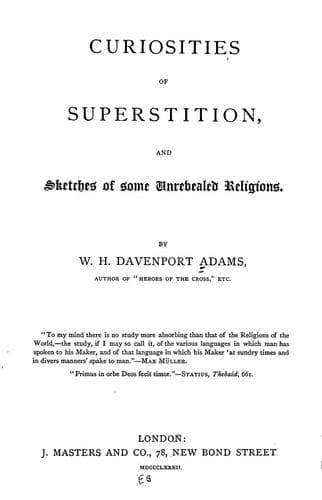
Curiosities of Superstition, and Sketches of Some Unrevealed ReligionsAdams, W. H. Davenport (William Henry Davenport)
Religion
Curiosities of Superstition, and Sketches of Some Unrevealed Religions
Adams, W. H. Davenport (William Henry Davenport)
Folklore; Religions; Superstition
Among the earlier superstitions of Scotland was a belief in the efficacy
of charms, or metrical incantations; a belief prevailing in almost every
country and period, and indirectly attesting man’s strong inward
conviction of the existence of another world. That communications could be
maintained with the unseen creatures that live in the air, and “the ooze;”
above, beneath, and around us; that they could be made to assume a bodily
form and presence; that storms could be raised or dispelled, evil
prevented, secrets discovered, diseases cured, love engendered,--and that
all this was possible by the utterance of certain words arranged in
metrical form, though generally perfectly meaningless, was never doubted.
Many of those used in Scotland evidently had their origin in the reputed
efficacy of verses among the ancients; and being of an early date, they
are often “intermixed with the formula of the Roman Catholic ritual.” Thus
we read that one Elspeth Reoch (in 1616) had been supernaturally
instructed to cure distempers by resting on her right knee while pulling a
certain herb “betwixt her midfinger and thumb, and saying of, _In nomine
Patris, Filii, et Spiritus Sancti_.” An old and popular charm for curing
cattle (1607), is given by Dalyell as follows:--[69]
“I charge thee for arrow shot,
For deer shot, for womb shot,
For eye shot, for tongue shot,
For liver shot, for lung shot,
For heart shot,--all the most:
In the Name of the FATHER, the SON, and HOLY GHOST.
To wind out of flesh and bone,
Into oak and stone:
In the Name of the FATHER, the SON, and HOLY GHOST.
Amen.”
Sometimes these invocations were accompanied by the administration of
medicinal herbs which had been gathered before sunrise. A woman accused of
witchcraft, in 1588, declared that she saw “the guid nychtbours makand
thair sawis with pains and fyres, and gadderit thair herbis before the
sone rysing as sche did.” Among the various remedies prescribed for “the
trembling fever,” or ague, by Katharine Oswald, one related to plucking up
a nettle by the root, three successive mornings, before sunrise. A
favourite time for this herb-gathering rite was Midsummer; a relic of the
old Pagan superstition connected with the sun’s position in the Zodiac.
The metrical charm then made use of was popular also in England,--
“Haile be thou, holie hearte,
Growing on the ground;
All in the Mount Calvarie
First wast thou found.
Thou art good for manie a sore,
And healest manie a wound;
In the Name of Sweet JESUS,
I take thee from the ground.”
Public-domain text, read in full here on John Shaqi.
Reviews
Reviews
No reviews yet
Be the first to share your thoughts on this work.
Elsewhere in the archive
Join the Discussion
Join the discussion
Sign in to leave a comment or review.
Sign InorCreate an account